
Last Updated: October 24, 2026
Quick Summary
Salon retail sales starts with the consultation: listen to client needs, ask targeted questions about hair goals and routines, and position products as solutions to specific problems they mention. Stylists who master this approach, asking about hair challenges, styling time, and past products tried, consistently convert consultations into purchases by connecting recommendations directly to what clients shared.
- Ask three key questions during consultation: What's your biggest hair challenge, how much time do you have for styling, and what have you tried before
- End consultations by summarizing what you heard and explaining how your product recommendation solves that specific problem
- Provide written instructions and demonstrate correct application so clients understand how to use products at home
- Track four metrics monthly: recommendation rate, conversion rate, average retail transaction, and repeat purchase rate to identify where sales are lost
- Create incentives and role-play objections with staff to build confidence in product knowledge and recommendation skills
Table of Contents
- Master the Salon Retail Sales Consultation
- Salon Product Recommendation Examples That Convert
- Build Client Knowledge Through Aftercare Education
- Train Staff on Product Knowledge and Sales Techniques
- Salon Retail Display Ideas That Drive Purchases
- Salon Retail Sales Scripts for Common Client Objections
- Salon Retail Sales Goals and Metrics That Matter
- Start Building Your Retail Revenue Strategy Today
- Frequently Asked Questions
Master the Salon Retail Sales Consultation
Salon retail sales starts with the consultation: listen, learn what clients need, and position products as solutions, not extras.
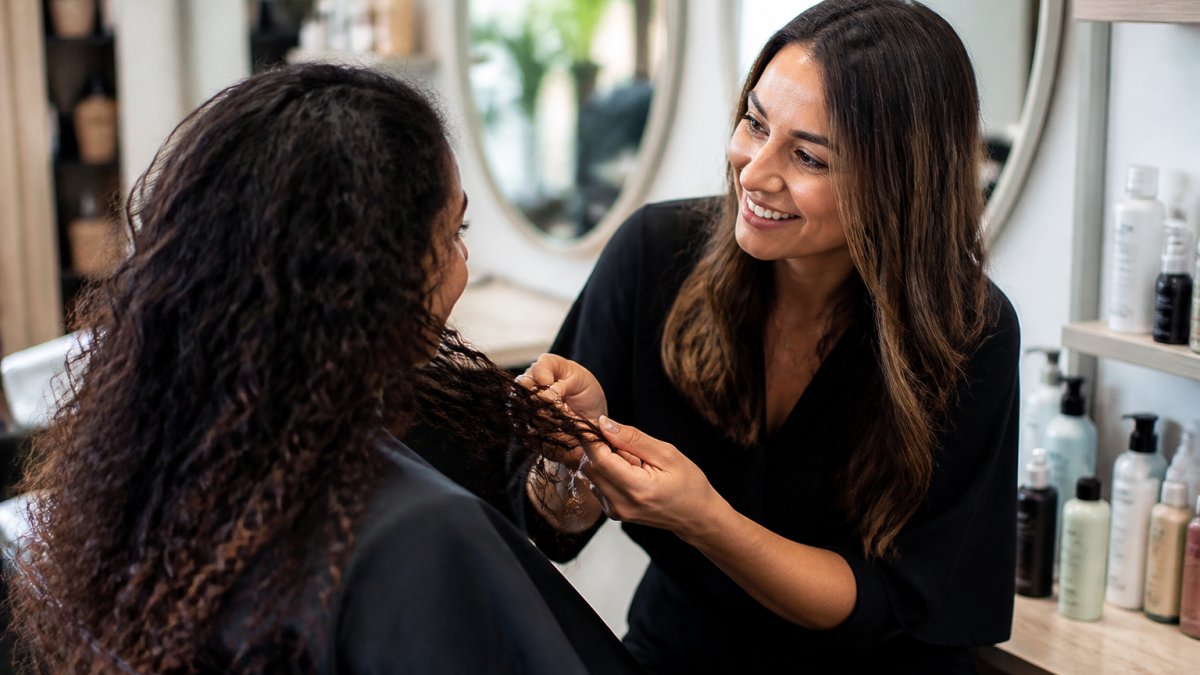
Ask open-ended questions about hair goals and routines: what they use at home, how much time they spend styling, what frustrates them most.
End by summarizing what you heard and how your recommendation solves it. Clients who remember why they bought are more likely to repurchase.
Salon Product Recommendation Examples That Convert
Recommendations work best when specific and tied to the consultation.
Here are practical examples for common client situations:
For over-processed or damaged hair: "Your hair shows signs of heat damage from styling. This restorative serum helps rebuild strength and shine (Health improvement of human hair and their reshaping using recombinant keratin K31). Apply it twice weekly to the ends."
For frizz and humidity concerns: "Frizz happens when moisture enters the hair shaft.
For clients with textured or curly hair: "Keratin treatments work beautifully on all hair types, including textured hair.
For busy clients: "You mentioned you don't have time for a complicated routine. This two-step system is designed to be quick.
Build Client Knowledge Through Aftercare Education
Educated clients become repeat customers.
Aftercare education starts during the service.
After the service, walk through the at-home routine step by step: how much product, how to apply it, how often.
Provide written instructions, a simple card with the routine, frequency, and key benefits, to reduce confusion and increase compliance.
Consider a brief video of the routine.
You can learn how to explain product ingredients to clients so they understand what they're buying and why it matters. You can also explore guidance on maintaining professional treatments to help clients get the most from their salon investment.
The goal is making clients feel like insiders.
Train Staff on Product Knowledge and Sales Techniques
Your team's product knowledge directly impacts retail sales.
Start with foundational training. Every team member should know:
- What each product does and which hair types it's best for
- Key ingredients and their benefits
- How to use each product correctly
Rotate product training into team meetings: 10 minutes weekly on one product, covering benefits, application, and role-played recommendations. This keeps knowledge fresh and builds confidence.
You can help staff learn to read and explain professional product labels so they can confidently communicate with clients about what they're recommending.
Create incentives for retail sales. Commission structures, bonuses, or contests motivate stylists to prioritize retail conversations and engage more actively in recommendations.
Role-play common objections.
Hold stylists accountable. Track retail sales per stylist and per service, celebrate top performers, and coach those who struggle.
Salon Retail Display Ideas That Drive Purchases
Where you place products matters as much as what you stock.
Place products at the checkout area, your highest-traffic zone.
Create a dedicated retail wall near the service area.
Use before-and-after photos of your salon's actual clients using the products.
Stock trial sizes alongside full sizes.
Place products in treatment rooms.
Create seasonal displays: moisture and frizz control in winter, heat protection in summer.
Salon Retail Sales Scripts for Common Client Objections
Objections are not rejections, they're requests for more information at the moment a client feels uncertain. These scripts are written to be said naturally, each paired with a follow-up that keeps the sale alive without pressure.
When to use each script
Timing matters as much as wording. The best moment to address an objection is usually before it forms. Mention the product during the service, explain the benefit while you apply it, and let the client handle and smell the product before checkout. By the time you reach the register, the objection is often smaller.
Scripts for common objections
"I'll try it at home first."
Response: "That makes sense.
"That's too expensive."
Response: "I understand. Let's look at what you actually need.
Follow-up: Offer a concrete alternative rather than defending the price.
"I'll just buy it online cheaper."
Response: "You might find a lower price somewhere, and I won't talk you out of saving money.
"I don't have time for another step."
Response: "I hear that a lot.
Follow-up: Demonstrate the product on a small section.
"I need to think about it."
Response: "Absolutely. I'll write down exactly what I recommend and why, so you have it when you're ready.
Build a follow-up system around objections
The script is only half the work. Record every objection and the product discussed in the client's notes. At the next appointment, open with a check-in: "How did the product work out?" If they bought it, ask about results. If they did not, ask what held them back. This turns a one-time objection into a second conversation.
Train the team on objection handling
Role-play these scripts in weekly team meetings, but rotate the scenarios so stylists practice the ones they find hardest. Record which objections come up most often at your salon and update the scripts to match your actual product assortment and price points. A script that does not fit your products or your clients' budgets will sound forced and backfire.
Salon Retail Sales Goals and Metrics That Matter
A retail conversion funnel breaks the client journey into measurable stages so you can see exactly where recommendations are failing to become purchases and purchases are failing to become repeat business.
Map the retail conversion funnel
Think of every service client as moving through four stages:
- Recommendation rate, the percentage of service clients who receive at least one specific product recommendation during their visit.
- Conversion rate, the percentage of those recommended clients who actually buy at least one product.
- Average retail transaction, total retail revenue divided by the number of retail transactions.
- Repeat purchase rate, the percentage of retail buyers who purchase the same product again within a defined window (typically 60-90 days, depending on product size and usage).
Each stage has a different fix. A low recommendation rate points to staff habits or confidence. A low conversion rate points to consultation quality, objection handling, or pricing presentation. A low average transaction points to assortment and bundling. A low repeat rate points to product fit, aftercare education, or follow-up.
Calculate each metric with real formulas
Use your point-of-sale and booking data to compute these monthly:
- Recommendation rate = (number of service tickets with a product recommendation logged) ÷ (total service tickets). If your POS cannot log recommendations, add a simple checkbox or note field to the ticket.
- Conversion rate = (retail transactions) ÷ (service tickets with a recommendation).
- Average retail transaction = (total retail revenue) ÷ (number of retail transactions).
- Retail-to-service ratio = (total retail revenue) ÷ (total service revenue).
Set benchmarks you can actually hit
There is no universal benchmark that fits every salon, so establish your own baseline first. Pull the last three months of data and calculate each metric. Then set a target that moves one stage at a time.
The biggest early gains can come from lifting the recommendation rate, because it requires only a habit change, not a pricing or assortment overhaul.
Diagnose where sales are lost
Use the funnel to locate the bottleneck rather than guessing:
- High recommendation rate, low conversion, review objection handling and price presentation. Are stylists recommending products that match the client's stated routine and budget?
- High conversion, low average transaction, check whether stylists offer a complementary second product or a bundle. Single-item purchases cap your average.
- High average transaction, low repeat rate, audit product fit and aftercare education. Clients who do not understand how to use a product rarely repurchase it.
- Low recommendation rate across the team, look at training, incentives, and whether product knowledge is current.
Connect metrics to inventory and margin
Retail revenue is not the same as retail profit. When you review these metrics, subtract discounts, staff commissions, and the cost of unsold stock. A product with high sales but heavy discounting or a high commission rate may contribute less margin than a slower-moving product sold at full price. Track sell-through by SKU monthly and flag products that sit beyond 90 days without selling.
Track these four key metrics monthly to identify where your retail sales process is succeeding or losing clients.
| Metric | Formula | What it reveals |
|---|---|---|
| Recommendation rate | Tickets with recommendation ÷ total tickets | Whether stylists are making recommendations |
| Conversion rate | Retail transactions ÷ recommended tickets | Whether recommendations become purchases |
| Average retail transaction | Total retail revenue ÷ transactions | Whether clients buy single or multiple items |
| Repeat purchase rate | Repurchases within 60-90 days ÷ prior buyers | Whether clients repurchase the same product |
Start Building Your Retail Revenue Strategy Today
Salon retail sales aren't about pushing products. They're about understanding client needs, offering genuine solutions, and educating people so they feel confident buying.
Your product selection matters too. Clients notice quality. They notice when products deliver the results you promised.
Begin tracking your retail metrics this month. Set a goal for next quarter. Train your team on the consultation and recommendation strategies outlined here.
Frequently Asked Questions
How can a salon increase retail sales without being pushy?
The key is shifting from selling to educating. During the client consultation, identify their specific hair challenges and recommend products that solve those problems. Explain the benefits tied to their goals (frizz control, shine, damage repair) rather than listing features. Make recommendations feel like professional advice, not a sales pitch. When clients understand why a product matters for their hair type, they view the purchase as necessary maintenance rather than an upsell.
What should salon retail sales goals and metrics track?
Track retail revenue as a percentage of total salon revenue (most salons aim for 20-30% retail contribution). Monitor average transaction value per client, retail conversion rate (percentage of clients who purchase), and repeat purchase frequency. Measure product performance by category to identify top sellers. Set staff-level sales goals tied to commission or incentives. Review these metrics monthly to identify trends and adjust product assortment or training as needed.
How do you know which salon retail display ideas actually work?
Effective displays place high-margin, frequently recommended products at checkout where clients make impulse purchases. Group complementary items together (shampoo with conditioner, treatment with leave-in spray). Rotate featured products monthly to highlight seasonal needs or new inventory. Use before-and-after photos or client testimonials near displays to build trust. Track which display locations generate the most sales by monitoring inventory turnover and client feedback.
What makes salon product recommendation examples more effective than generic suggestions?
Specific recommendations tie directly to the client's stated needs and hair condition. Instead of "try this shampoo," say "This sulfate-free formula will protect your keratin treatment and extend results for weeks longer." Reference what you observed during the service: "Your ends showed dryness, so this restorative serum targets that." Personalized recommendations feel tailored and trustworthy, increasing the likelihood the client buys and returns for more.
Building a thriving salon retail business takes intention and system. The strategies in this guide create that system. Implement them with your team, track your progress, and adjust based on what the data shows. Your salon's retail revenue, and your team's income, will grow as a result.
