
Last Updated: October 23, 2026
Quick Summary
To explain hair product ingredients to clients, read the ingredient label by concentration order, focus on the first five ingredients which account for roughly 80% of what the product does, and match specific ingredients to client hair concerns. This builds trust and positions you as an expert.
- Ingredients are listed by concentration from highest to lowest, with the first ingredient making up the largest percentage of the product
- The first five ingredients tell you almost everything you need to know about what a product does
- Sulfates are powerful cleansers that can strip natural oils, while gentler surfactants like cocamidopropyl betaine clean effectively but leave more natural oils behind
- Silicones add shine and smoothness but can build up over time, requiring clarifying shampoo every 4-6 weeks to prevent dullness
- Ask clients five consultation questions about their main concern, wash frequency, past reactions, current routine, and budget before recommending products
Table of Contents
- Why Clients Need Clear Ingredient Explanations
- How to Read Hair Product Ingredient Labels
- Hair Product Ingredients and Their Functions
- Hair Product Consultation Questions for Clients
- Salon Product Recommendation Script
- Handling Sensitivities and When to Refer
- Frequently Asked Questions
Why Clients Need Clear Ingredient Explanations
When a client asks what's actually in their shampoo, the conversation often stalls. They've heard confusing terms. They've read scary headlines about sulfates and parabens. They don't trust what they're being sold.
At Kerarganic Cosmetics, LLC, we work with salon professionals and home-care users who want to explain hair product ingredients and understand what they're putting on their hair.
A clear explanation of hair product ingredients builds trust instantly. It separates you from competitors who just hand over a bottle. It positions you as the expert.
How to Read Hair Product Ingredient Labels
Reading an ingredient label correctly is the foundation of everything else. Learn how to read professional hair product labels to decode what's actually in each bottle. Most people glance at the front of the bottle and assume it tells them what matters. It doesn't.
The ingredient list on the back tells the real story. And there's a system to understanding it.
Understanding Ingredient Order and Concentration
Ingredients are listed by concentration, from highest to lowest (the FDA). The first ingredient makes up the largest percentage of the product. The last ingredient makes up the smallest amount.
This matters because it changes how the product actually performs. A shampoo that lists water first and sulfates fifth will perform very differently from one that lists sulfates second.
The first five ingredients tell you almost everything you need to know about what a product does. Focus there first. If you're explaining a product to a client, these are the ones worth discussing.
Decoding the First Five Ingredients
The opening ingredients reveal the product's primary function and quality level.
Water or aqueous base. Almost every hair product starts here. Water is the carrier. It's not a filler, it's essential.
Cleansing agents (surfactants). If you see sodium lauryl sulfate or sodium laureth sulfate early in the list, the product is a strong cleanser.
Conditioning agents. Look for ingredients like cetyl alcohol, stearyl alcohol, or silicones. These coat the hair and smooth the cuticle.
Proteins and humectants. Hydrolyzed keratin, hydrolyzed collagen, or glycerin in the top five mean the product is designed to strengthen and add moisture. These are active repair ingredients, not just fillers.
Oils and butters. Argan oil, coconut oil, shea butter, these nourish and protect.
| Ingredient Position | What It Tells You | Client Conversation |
|---|---|---|
| Position 1-2 | Primary function | "This is a strong cleanser" or "This is a moisturizing treatment" |
| Position 3-5 | Secondary benefits | "It also conditions" or "It adds protein for strength" |
| Position 6+ | Supporting ingredients | "These enhance the main effects" |
Hair Product Ingredients and Their Functions
Every ingredient in a hair product serves a purpose. Understanding these categories helps you explain why a specific product works for a specific hair type or concern.
Cleansing Ingredients and Surfactants
Surfactants are the workhorses of shampoo. The word means "surface-active agent." They grab oil and dirt, suspend them in water, and rinse them away.
Different surfactants have different strengths. Sulfates like sodium lauryl sulfate are powerful and inexpensive. They clean aggressively. They're also the ingredient people worry about most.
Gentler surfactants like cocamidopropyl betaine or decyl glucoside clean effectively but leave more natural oils behind.
When a client asks "Is this sulfate-free?", they're usually asking "Will this strip my hair?" The honest answer: sulfate-free doesn't automatically mean gentle.
Conditioning Agents and Emollients
Conditioning agents coat the hair shaft and smooth the cuticle layer. This is what makes hair feel soft and manageable.
Common conditioning agents include:
- Silicones (dimethicone, cyclomethicone): These are synthetic polymers that coat hair and add shine. They're effective but can build up over time if not clarified regularly.
- Fatty alcohols (cetyl alcohol, stearyl alcohol, cetearyl alcohol): These are plant-derived and much less likely to build up than silicones. They condition without the heaviness. They're a sign of a more premium formulation.
- Oils and butters (argan oil, coconut oil, shea butter, jojoba oil): These are natural emollients. They penetrate the hair shaft and nourish from within. Higher concentrations mean deeper conditioning.
Humectants like glycerin, sorbitol, and panthenol pull moisture from the air into the hair. They're especially valuable for dry or curly hair that needs extra hydration.
When explaining conditioning ingredients to clients, focus on the result: "This product uses argan oil, which makes your hair feel smoother and shinier." Skip the chemistry unless they ask.
Silicones, Sulfates, and Parabens Explained
These three ingredients generate the most client questions. Here's what clients actually need to know.
Silicones (dimethicone, amodimethicone, cyclomethicone): Silicones coat the hair and add instant shine and smoothness. They're safe and effective. The downside is buildup.
Sulfates (sodium lauryl sulfate, sodium laureth sulfate, ammonium lauryl sulfate): Sulfates are powerful cleansers. They're inexpensive, which is why they're in most drugstore shampoos.
Parabens (methylparaben, propylparaben, butylparaben): Parabens preserve products and prevent bacterial and fungal growth (Effect of Commonly Used Cosmetic Preservatives on Healthy Human Skin Cells).
Preservatives and Fragrance
Preservatives keep products safe by preventing mold, bacteria, and fungi from growing. Without them, a product would develop contamination within days. Common preservatives include parabens, phenoxyethanol, and methylisothiazolinone.
Fragrance is listed as a single ingredient on the label, but it's actually a blend of dozens of compounds. Fragrance can irritate sensitive scalps. If a client has scalp sensitivity or contact dermatitis, fragrance-free products are worth trying.
Some clients worry about "fragrance" because they think it hides something. The truth: fragrance disclosure is regulated.
Hair Product Consultation Questions for Clients
Before recommending a product, ask questions.
VOLUME PLUS THICKENING FORTIFYING BIOTIN AND COLLAGEN SHAMPOO →
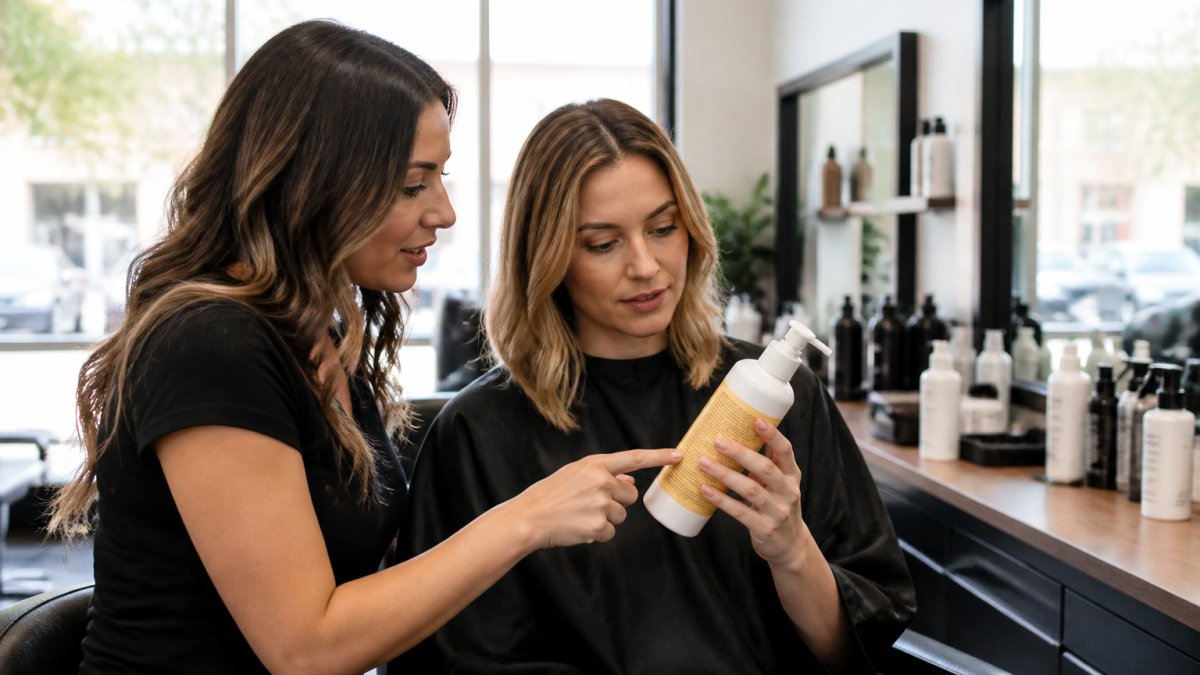
What's your main hair concern right now? Frizz, dryness, breakage, flatness, color fading. Listen for the specific problem.
How often do you wash your hair? Daily washing calls for gentler sulfates or sulfate-free formulas.
Have you had any reactions to products in the past? Allergies, scalp sensitivity, or buildup issues.
What does your current routine look like? Are they using heat tools, color treatments, or styling products?
What's your budget? Premium products cost more. Some clients are willing to invest.
These five questions take two minutes. They completely change the conversation from "Here's what I recommend" to "Here's what I recommend for you specifically."
Salon Product Recommendation Script
Once you know what a client needs, here's how to present the product and its ingredients in a way that lands.
Opening the Conversation
Start with the problem, not the product.
"You mentioned your hair gets frizzy by midday. That usually means two things are happening: your hair isn't getting enough moisture, and the cuticle isn't sealed. I have a product that addresses both."
This frames the recommendation as a solution to their stated problem, not a sales pitch.
Addressing Ingredient Concerns and Myths
When a client says "I don't want sulfates," don't just nod and hand them sulfate-free. Explain why.
"Sulfates are strong cleansers. They work great if your scalp is oily and you need deep cleaning.
When a client worries about parabens or silicones, acknowledge the concern and give context.
"I understand the concern about silicones. They do build up over time. But they also add shine and smoothness that clients love.
When a client asks about "chemicals," reframe the conversation.
"Everything is made of chemicals, water is a chemical, salt is a chemical, the keratin in your hair is a chemical.
Closing with a Product Match
End with a specific recommendation tied to their needs and the product's ingredients.
"Based on what you told me, I'm recommending our Xtreme Repair Leave-In Conditioner.
Notice what's happening here: you named the specific ingredients, explained what they do, and told them what to expect. This is the kind of recommendation that sticks.
For clients interested in a complete system, Volume Plus Thickening Fortifying Biotin and Collagen Shampoo pairs well with a conditioner.

Handling Sensitivities and When to Refer
Some clients have genuine sensitivities or allergies. Some have scalp conditions that need medical attention. Know the difference.
Sensitivities to watch for:
- Fragrance sensitivity: redness, itching, or burning on the scalp
- Preservative sensitivity: contact dermatitis or rash
- Protein overload: buildup, stiffness, or brittleness from too much conditioning protein
For fragrance or preservative sensitivity, recommend fragrance-free or preservative-free alternatives. These exist and work well.
For protein overload, the fix is simple: alternate with a lighter conditioner or use a clarifying treatment.
When to refer to a dermatologist:
- Severe itching, flaking, or bleeding scalp
- Hair loss beyond normal shedding
- Persistent rash or hives that doesn't improve after stopping a product
- Suspected fungal infection (unusual odor, scaling, or discoloration)
These are medical issues, not product issues. Be honest about the limits of what you can address.
Explaining hair product ingredients to clients isn't complicated.
Kerarganic Cosmetics, LLC products are formulated with professional-grade ingredients like hydrolyzed keratin, argan oil, and biotin designed to deliver visible results. When you understand how these ingredients work and can explain them confidently, you're not just selling a product, you're delivering expertise. SHOP NOW
Frequently Asked Questions
How do you explain hair product ingredients in simple terms?
Start with the product's main purpose, then break down the top three to five ingredients using everyday comparisons. For example, describe surfactants as 'the cleaning agents that lift away buildup,' and conditioning agents as 'the moisturizers that add softness.' Avoid chemical names; instead, explain what each ingredient does for their specific hair type and concern. Use phrases like 'this ingredient helps repair damage' or 'this one reduces frizz' to connect the ingredient to a visible benefit.
What should clients look for on a hair product label when reading ingredients?
Clients should check the first five ingredients, as these make up the bulk of the formulation. They should also identify whether the product contains sulfates (harsh cleansers), silicones (which add shine but can build up), and parabens (preservatives some prefer to avoid). Reviewing the ingredient list helps clients understand if a product matches their hair type, for example, someone with curly hair benefits from humectants and oils, while fine hair needs lightweight conditioning agents. Always recommend reading labels to match their specific hair needs.
How can you help a client choose a hair product for their hair type?
Ask about their hair texture, porosity, and primary concern (frizz, damage, volume, color maintenance). Then match those needs to the product's ingredient profile. For over-processed or damaged hair, recommend products with hydrolyzed proteins and nourishing oils, like Kerarganic's XTREME REPAIR LEAVE-IN CONDITIONER PROTEIN COMPLEX, which contains argan oil and hydrolyzed silk to strengthen and add shine. For fine or thin hair, suggest lightweight formulas with biotin and volumizing agents. Always explain why specific ingredients in that product solve their problem.
What should you do if a client is worried about a specific ingredient?
Listen without dismissing their concern, then explain the difference between an ingredient's potential hazard and its actual risk in the product. For example, if they worry about formaldehyde, reassure them that formaldehyde-free keratin treatments (like Kerarganic's ORGANIC KERATIN SYSTEM) use alternative amino acids to achieve the same straightening and smoothing results without harmful chemicals. If they have a known allergy or sensitivity, refer them to a dermatologist before recommending the product. Never pressure them; building trust means respecting their preferences and providing transparent information.
