
Last Updated: November 11, 2026
Quick Summary
To market sustainable salon services to clients, audit and document exactly what makes each service sustainable, then promote only claims you can substantiate, such as formaldehyde-free formulas or refill stations. Run one coordinated campaign across your website, email, social, booking flow and in-salon signage, and track bookings, retail conversion, repeat visits, engagement and waste diverted monthly.
- Audit your products, waste, energy savings and supplier credentials before writing any marketing content.
- Formaldehyde-free smoothing treatments are a strong marketing anchor because the benefit is health-related.
- Only claim what you can document, following the FTC Green Guides standard for environmental claims.
- Segment clients into health-first, value-first and planet-first groups, then test a different lead message for each.
- Record one month of baseline numbers before campaigning so you can compare results afterward.
Table of Contents
- Step 1: Audit Your Sustainable Salon Services Before You Market Them
- Step 2: Build Your Sustainable Salon Services Examples List
- Step 3: How to Promote a Sustainable Salon Without Greenwashing
- Step 4: Eco-Friendly Salon Marketing Ideas That Reach Clients
- Step 5: Eco-Friendly Salon Social Media Content That Converts
- Step 6: Segment Clients and Test Your Green Marketing Messages
- Step 7: Measure Marketing and Business Outcomes
- Stock the Sustainable Retail Shelf Your Clients Will Rebook For
- Frequently Asked Questions
Step 1: Audit Your Sustainable Salon Services Before You Market Them
The global salon services market reached $264.93 billion in 2025 and is projected to hit $284.53 billion in 2026, according to Fortune Business Insights market data.
At Kerarganic Cosmetics, LLC, we see this pattern constantly. A stylist buys a green product line, posts a few photos, and waits for eco-conscious clients to appear.
So before you write a single caption, list what you actually do:
- Which products are formaldehyde-free or sulfate-free
- What waste you recycle and how
- Where your energy savings come from
- Which suppliers hold real environmental credentials
That list becomes your marketing foundation. Skip it and you'll be guessing.
What Counts as a Sustainable Salon Service
A sustainable salon service is any treatment or retail offering whose environmental impact is lower than the standard version, and that you can prove. That's the definition that matters.
This is where most guides get vague. They list "eco-friendly products" without saying which ones qualify. A formaldehyde-free smoothing treatment counts. A shampoo in a refillable bottle counts.
If you need help deciding which of your lines qualify, compare sustainable product lines side by side before you market them. For concrete options, see these ammonia-free hair smoothing treatments.
Step 2: Build Your Sustainable Salon Services Examples List
Concrete examples beat adjectives every time. Vague claims like "we care about the planet" convince nobody. Specific services sell.
Here's how we'd structure the list:
| Service | What Makes It Sustainable | Client Benefit |
|---|---|---|
| Formaldehyde-free smoothing | No formaldehyde in the formula | Safer air during the service |
| Sulfate-free retail line | Gentler on treated hair | Longer-lasting color |
| Refill station | Reusable bottles | Lower plastic waste |
| Solid shampoo bars | Plastic-free packaging | Travel-friendly |
That table does more selling than a paragraph of green buzzwords. Clients understand it in seconds.
Formaldehyde-Free Treatments as a Marketing Anchor
Formaldehyde-free treatments are the strongest anchor most salons have, because the benefit is health-related, not just environmental. Clients ask about it directly.
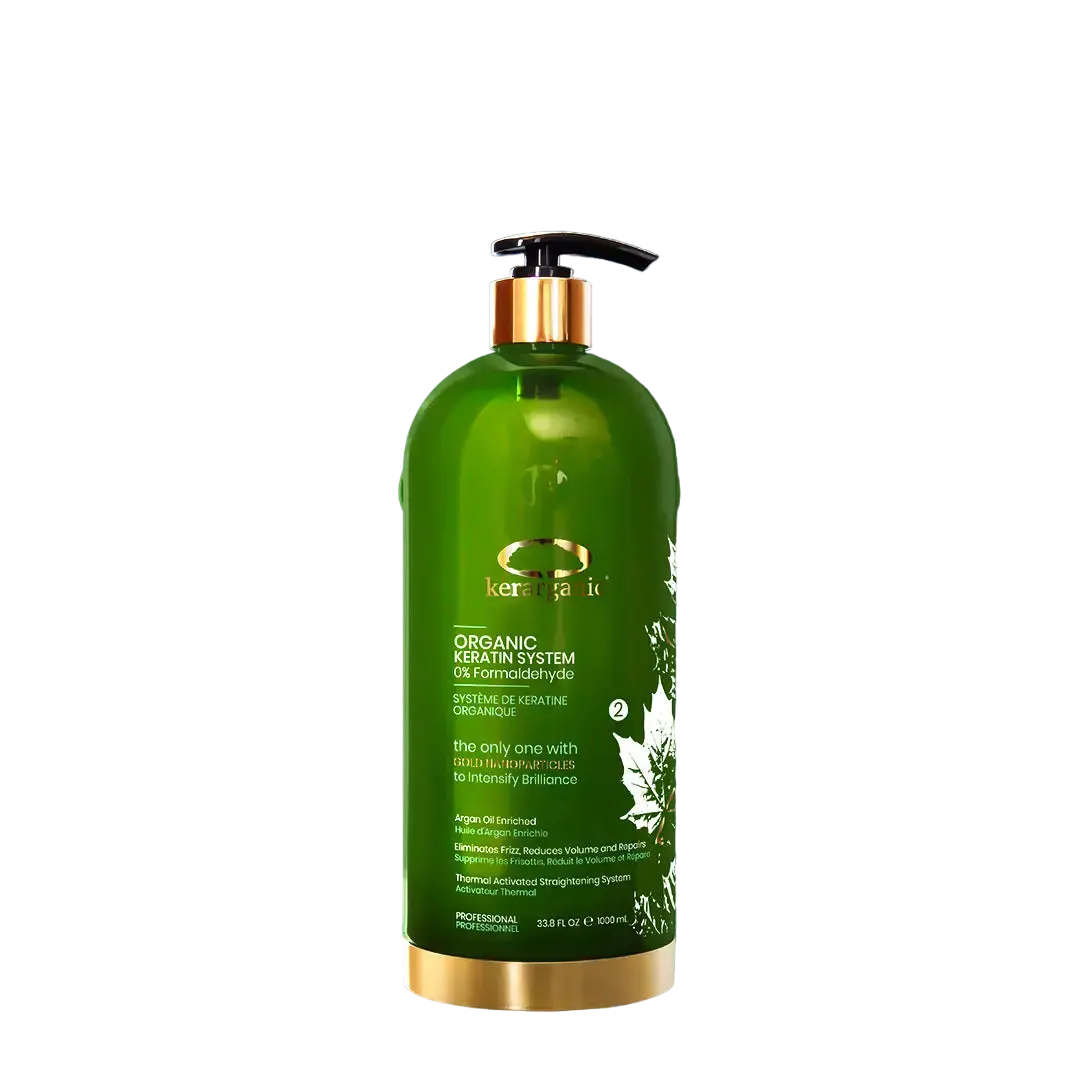
Our Organic Keratin System Premium is a formaldehyde-free smoothing treatment that straightens curly, wavy or frizzy hair for up to 5 months. It's 100% vegan. That's a service you can describe honestly and price with confidence.
Step 3: How to Promote a Sustainable Salon Without Greenwashing
Greenwashing is the fastest way to lose client trust. The fix is simple: only claim what you can document.
The Federal Trade Commission says its Green Guides exist to help marketers avoid misleading environmental claims. That's the standard your marketing should meet.
Practical rules we recommend:
- Say "formaldehyde-free" only if the product is
- Say "recycled packaging" only if you can name the material
- Drop words like "clean" and "natural" unless you define them
- Keep supplier documentation on file
Substantiating Claims with the FTC Green Guides
Every environmental claim needs a paper trail. If a client asks "how do you know?", you need an answer.
Before you call a keratin product organic, check whether that claim holds up. Our guide on whether salon keratin products are organic walks through what the label can and cannot support.
Step 4: Eco-Friendly Salon Marketing Ideas That Reach Clients
Eco-friendly salon marketing ideas work best when they run as one coordinated campaign across every channel a client touches, not as isolated props in the salon. Keeping those messages credible means checking that the products behind each sustainable service match the claims clients see, so teams should vet eco friendly brands before building them into the campaign.
Here is a practical channel plan you can run in a single quarter.
Website: Make Sustainable Services Findable and Provable
Give each sustainable service its own page or section with three elements: what makes it sustainable, what the client gets, and how you substantiate the claim. For a formaldehyde-free smoothing treatment, that means naming the formula standard, stating the expected wear time, and linking to supplier documentation on request. Put a booking button on every sustainable service page so interest converts without a detour.
Email: Segment the List and Sequence the Story
Build a three-email sequence for clients who have already had a sustainable service: a thank-you with home-care instructions, a proof email that explains one environmental practice in plain language, and a rebooking reminder timed to the service's wear cycle. For a smoothing treatment that lasts up to five months, the rebooking nudge belongs around month four.
Social: Show the Mechanism, Not the Mood
Pair each post with a service-menu link. Avoid stock imagery of leaves; clients read it as decoration, not proof.
Booking: Reduce Friction at the Decision Point
Add a note to the online booking flow for relevant services, such as "formaldehyde-free formula" next to the smoothing treatment. A common pattern is that clients who arrive already knowing the service is formaldehyde-free ask fewer objection questions at the chair.
In-Salon: Reinforce What the Campaign Promised
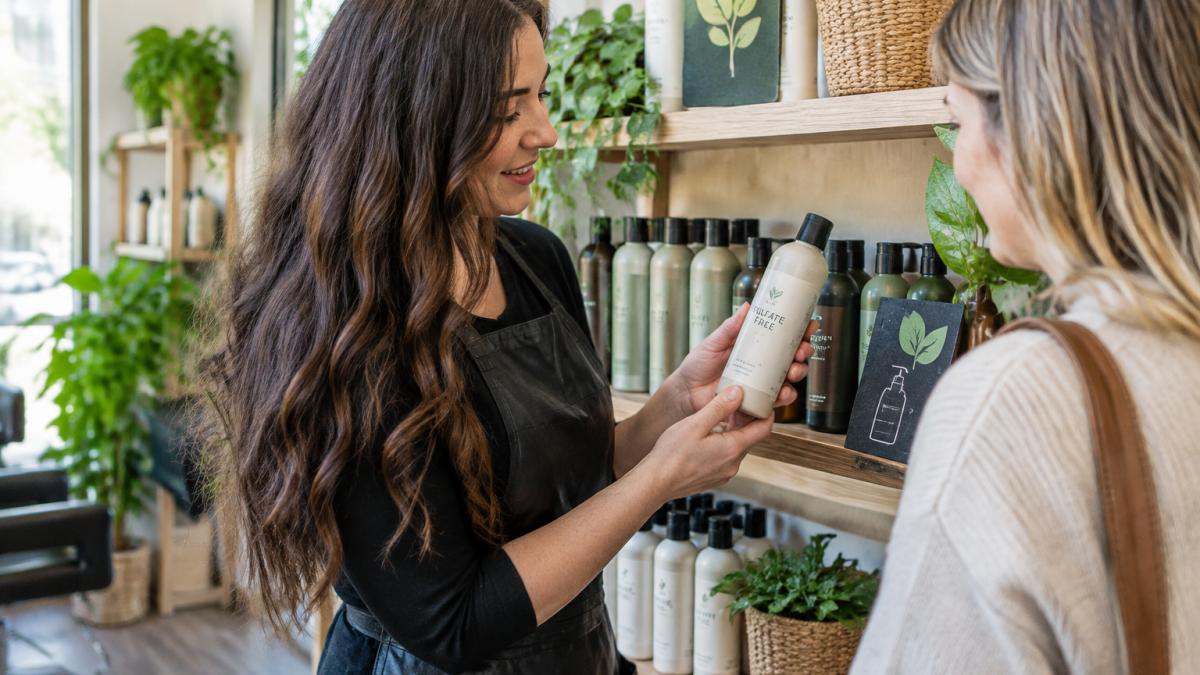
Use signage at each station naming the service and its key benefit. These props should repeat the same language used online so the client experiences one consistent message.
In-Salon Messaging and Service Scripts
Scripts keep your team consistent across every channel. Here is one we would use at the chair:
"This treatment is formaldehyde-free. It smooths for up to five months, and I'll show you the home care that keeps it that way."
Pair that with a booking-page line ("Formaldehyde-free smoothing, up to five months") and an email line ("The formula behind your smoothing results") so the same promise appears at every touchpoint. Short, specific, honest, and repeated. That is the whole formula.
Step 5: Eco-Friendly Salon Social Media Content That Converts
Post types that work:
- Before-and-after smoothing results with the product named
- A short clip of your refill station in use
- A staff post explaining why you dropped a harsh product
- Client testimonials about air quality during treatment
One caution: don't post a sustainability claim you haven't verified. One correction in the comments undoes months of trust.
Step 6: Segment Clients and Test Your Green Marketing Messages
Not every client cares about the same thing. Segment first, then test.
Split your list into three rough groups:
- Health-first clients: lead with formaldehyde-free and gentler formulas
- Value-first clients: lead with longer-lasting results and fewer appointments
- Planet-first clients: lead with waste reduction and refill options
Send each group a different message. Track which one books. Then double down on the winner.
Step 7: Measure Marketing and Business Outcomes
Marketing you can't measure is just noise. The competitive gap here is that most guides tell salons to "track results" without naming the numbers, the source system, or the review cadence. Here is a trackable framework you can run monthly.
The Five Numbers That Matter
- Sustainable-service bookings: count appointments for services you have classified as sustainable (for example, formaldehyde-free smoothing or refill-station retail consultations). Pull this from your booking system by service tag.
- Retail conversion: divide retail units sold by services delivered in the same period. Track the sulfate-free and refill lines separately so you can see whether the sustainable shelf is pulling its weight.
- Repeat visits: measure the share of clients who rebook within the expected wear cycle of their service. For a smoothing treatment marketed at up to five months, a rebooking inside month five is the signal.
- Campaign engagement: for each channel in the Step 4 plan, record opens or clicks for email, saves and profile visits for social, and page views for sustainable service pages. Attribute bookings to the channel where the client first engaged if your booking tool supports it.
Set a Baseline Before You Campaign
A common pattern is that salons launch a sustainability push without a baseline, then cannot tell whether anything changed. Before the campaign, record one month of the five numbers above. After the campaign, compare month over month and quarter over quarter. Small salons often find that retail conversion moves first, while repeat visits shift only after a full wear cycle.
Test Messages by Client Segment
Segment your list into three rough groups and send each a different lead message:
- Health-first clients: lead with formaldehyde-free and gentler formulas.
- Value-first clients: lead with longer-lasting results and fewer appointments.
- Planet-first clients: lead with waste reduction and refill options.
Track which segment books at the highest rate and double down on the winning message. This is the message-testing step most competitors skip, and it is where the marketing plan earns its keep.
Review Cadence and What to Do With the Data
Review the five numbers monthly and the segment test quarterly. If sustainable-service bookings rise but retail conversion stays flat, the retail shelf or the chair script needs work. If campaign engagement is high but bookings are flat, the booking path is the bottleneck. If waste diverted is strong but no channel mentions it, you have an unused proof point.
A 2026 article states that 70% of consumers are willing to pay a premium for sustainable beauty, according to Hair Bar NYC's eco-friendly salon guide.
Research on sustainability practices among salon owners suggests these findings can inform business practices that improve success, per a Walden University dissertation.
Watch out: if you count a booking as "sustainable" only because the client mentioned the environment, your numbers inflate and your decisions get worse.
Stock the Sustainable Retail Shelf Your Clients Will Rebook For
Retail is where green marketing pays off twice. A client who buys the right home care keeps her smoothing results longer, and she books again.
Our sulfate-free shampoos start at $16.70, and the Angel Touch Color Care Bundle gives color-treated clients a full five-piece routine at $72.70. Pair that with a plan for increasing salon retail sales and your sustainable services start carrying their own weight.
The challenge is simple: most salons market sustainability as a feeling, not a fact. Build the audit, verify every claim, and stock products that deliver.
Frequently Asked Questions
How do you promote a sustainable salon without greenwashing?
Start with what you can prove. The FTC Green Guides are written to help marketers avoid misleading environmental claims, so only advertise practices you can document: formaldehyde-free treatment lines, recycling volumes, or energy-efficient lighting you actually installed. Replace vague phrases like eco-friendly with specific facts, such as up to 5 months of results from a formaldehyde-free smoothing service, and keep supplier documentation on hand for staff who answer client questions.
What are examples of sustainable salon services I can market?
Look at your menu for services with a clear environmental story. Formaldehyde-free smoothing treatments such as the Organic Keratin System Premium ($158.60) and the Fiberplasty Cationic Straightening System ($153.60) both avoid formaldehyde, which is a concrete claim clients can verify. Each example gives your marketing a specific, checkable detail instead of a general green promise.
How can salons explain their sustainability efforts to clients?
Train every staff member on a short, consistent script. For example: this treatment is formaldehyde-free and lasts up to 5 months with the recommended home care, which means fewer appointments and less product over time. Put the same language on reusable signage at the station and in booking confirmations. Consistency across in-salon messaging, social posts, and checkout conversations is what makes the claim stick and keeps clients from suspecting exaggeration.
How do sustainable salon practices help attract and retain clients?
Retention comes from proof: when clients see formaldehyde-free treatments, refillable products, and recycling in action, the salon experience feels credible rather than performative. Tie those practices to retail recommendations, such as sulfate-free aftercare, so care also supports client loyalty and repeat bookings.
Prices of Sustainable Salon Products and Treatments
