
Table of Contents
- Can You Use Keratin Treatment on Color Treated Hair?
- How Keratin and Hair Dye Interact
- Why Timing Matters More Than the Treatment Itself
- Does Keratin Treatment Fade Hair Color?
- The Best Shampoo for Keratin Treated and Color Treated Hair
- Step-by-Step: How to Apply a Keratin Treatment on Color Treated Hair
- Common Mistakes and How to Troubleshoot a Failed Result
- Conclusion
- Frequently Asked Questions
Last Updated: September 23, 2026
Can You Use Keratin Treatment on Color Treated Hair?
Yes, you can use a keratin treatment on color treated hair, but timing and technique decide whether your color survives. A keratin treatment coats the hair shaft with protein and seals the cuticle, and it works on colored hair when the color has fully settled first. Kerarganic Cosmetics, LLC provides formaldehyde-free keratin systems for hair that has been lightened, toned, or dyed and still needs frizz control without losing vibrancy.
Here is the part most guides skip. The color and the keratin are not enemies. The enemy is doing both jobs in the same week.
Below, we break down how long to wait, which color types need extra caution, and how to keep both your smoothness and your shade.
How Keratin and Hair Dye Interact
Keratin treatments and hair dye both act on the cuticle, the outer layer of the hair shaft. Dye pushes pigment into the cortex and lifts the cuticle to get there; a keratin treatment then lays protein over that cuticle and seals it flat.
That seal is why order matters: seal the cuticle before oxidative color has fully developed and the dye cannot finish oxidizing, so the shade reads dull or uneven.
Most guides stop at "pH matters." Here is what happens at the molecular level, because the ingredients decide the outcome.
The pH gap is wider than people assume. Permanent oxidative dye is alkaline, typically pH 9.5 to 10.5, because the alkalizer (usually ammonia or monoethanolamine) swells the cuticle so dye precursors enter the cortex.
The ingredients that actually interact:
- Ammonia or monoethanolamine (the alkalizer in permanent dye). These raise pH and open the cuticle. If a keratin treatment is applied while residual alkalizer is still active in the shaft, the acidic sealer neutralizes it mid-oxidation and the color never fully develops.
- Hydrogen peroxide or persulfate (the developer/lightener). These oxidize melanin and lift the cuticle further. Bleached hair has already lost a large share of its disulfide bonds, so it has less structural protein for the keratin to bond to.
- Glyoxylic acid or formaldehyde-releasing agents (the active in many smoothers). Glyoxylic acid-based and formaldehyde-free systems cross-link with keratin in the cortex under heat. Traditional formaldehyde-releasing systems (methylene glycol) do the same but more aggressively, and they are the ones most likely to strip direct-dye pigment because of the higher heat and stronger cross-linking.
- Hydrolyzed keratin and amino acids (the rebuilders). These are small enough to penetrate the cortex and fill gaps in the protein structure. They are the ingredients you want on color treated hair, because they rebuild rather than merely coat.
Why Timing Matters More Than the Treatment Itself
The waiting period between hair color and keratin does more for your result than the brand of either product. Color needs time to finish oxidizing and for the cuticle to close on its own. Keratin needs a cuticle that has already settled.
Wait Times by Color Type: Permanent Dye vs. Vivids
Different color types need different gaps. Here is how to plan it.
| Color Type | Minimum Wait Before Keratin | Why |
|---|---|---|
| Permanent dye | 2 weeks | Allows full color oxidation and cuticle sealing |
| Bleach and lightener | 3-4 weeks | Hair shaft needs protein recovery first |
| Semi-permanent color | 1-2 weeks | Lighter pigment, faster to settle |
| Vivids and fashion colors | 2-3 weeks, test first | Direct dyes sit on the surface and can lift |
| Toner only | 1 week | Toner is surface-level and fades fast |
Does Keratin Treatment Fade Hair Color?
A keratin treatment can fade hair color if the color has not fully set, or if the treatment uses high heat and an alkaline formula. Done correctly on settled color, a keratin service usually protects vibrancy rather than stripping it, because the sealed cuticle holds pigment in.
Fading happens for three reasons:
ANGEL TOUCH BRILLIANCE SERUM - PRODUCTS →
- Color oxidation was incomplete. Dye needs time to finish developing inside the cortex.
- The cuticle was still open. Sealing an open cuticle traps uneven pigment.
- Heat and pH were too aggressive. High heat plus an alkaline product lifts surface pigment.
pH Balance, Cuticles, and Why Fading Happens
Think of the cuticle as roof shingles. When they lie flat, pigment stays underneath and light reflects off the surface, which is what "shiny" actually means. When they lift, pigment escapes and the surface scatters light instead.
The Best Shampoo for Keratin Treated and Color Treated Hair
The best shampoo for keratin treated and color treated hair is a sulfate-free, color-safe formula that cleans gently and does not strip the seal. Sulfates lift the cuticle and pull pigment and protein out with them, shortening the life of every service you paid for.
Look for:
- Sulfate-free surfactants that clean without opening the cuticle
- No harsh salts, which break down the keratin seal
- Color-protecting ingredients like argan oil and aloe
- A gentle pH that keeps the cuticle closed
Step-by-Step: How to Apply a Keratin Treatment on Color Treated Hair
Applying keratin to color treated hair follows a strict order: clarify, dry, section, apply, seal, and cool.
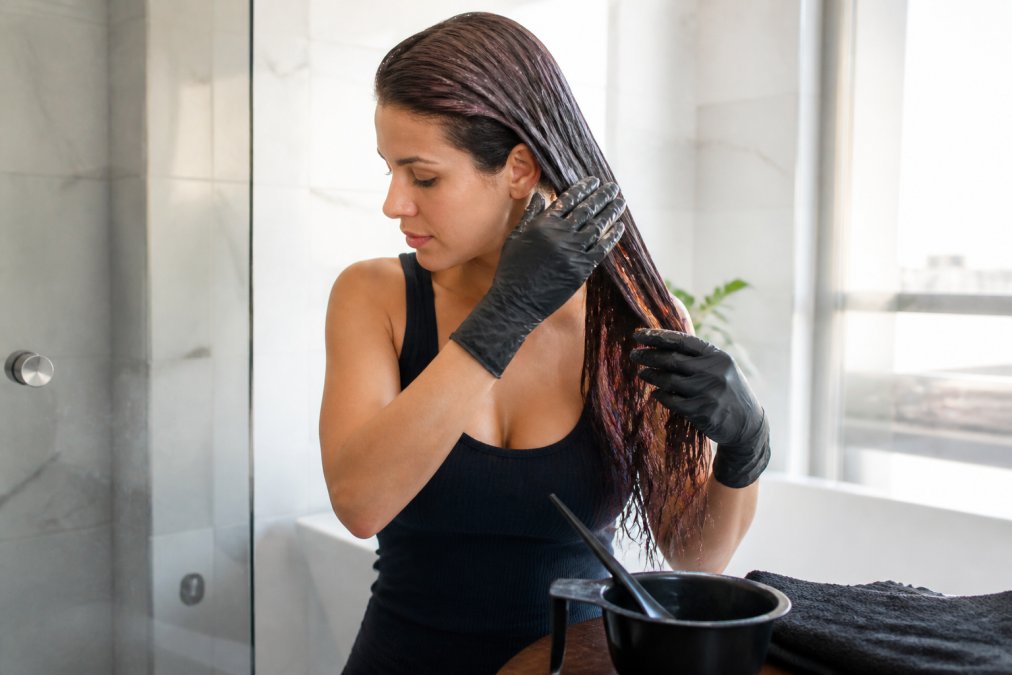
What you'll need:
- Sulfate-free clarifying shampoo
- Formaldehyde-free keratin treatment
- Wide-tooth comb and sectioning clips
- Gloves
- Flat iron rated for keratin sealing
- Heat protectant
Common Mistakes and How to Troubleshoot a Failed Result
| Problem | Likely Cause | Fix |
|---|---|---|
| Permanent color faded fast | Keratin done before oxidation finished | Wait the full window, then retone with a demi-permanent gloss |
| Vivid or fashion color bled or lifted | Direct dye sat on the surface and the sealer carried it off | Do not re-treat for 3-4 weeks; refresh with a color-depositing mask, not a new dye |
| Bleached hair snapped at mid-lengths | Sealed before the protein bond recovered | Stop heat, deep condition weekly, trim split ends before any retreatment |
| Patchy smoothness | Uneven application or hair not fully dry | Redo on dry, thin sections; moisture turns to steam and breaks the seal |
| Hair feels coated or greasy | Too much product near the scalp | Rinse and reapply from mid-length down only |
| Color looks dull or ashy | High heat plus an alkaline formula | Switch to an acidic, formaldehyde-free formula and lower the iron temperature |
- Permanent dye that faded immediately after treatment. This almost always means the keratin was applied before oxidation completed. Do not re-dye right away. Wait two weeks, then apply a demi-permanent gloss to refresh tone without another round of ammonia and peroxide. A second permanent dye service on top of a failed seal is how hair ends up over-processed.
- Vivids and fashion colors that bled. Direct dyes sit on the outside of the shaft, and a keratin sealer can physically lift that pigment. If your vivid faded within days of treatment, do not re-treat. Wait three to four weeks and refresh with a color-depositing conditioner or mask, which adds pigment without opening the cuticle.
- Bleached hair that feels gummy or snaps. This is a protein-loss problem, not a keratin problem. Sealing bleached hair too early traps a weakened shaft under a coating, and breakage shows up at the mid-lengths two to three weeks later. Deep condition with hydrolyzed keratin and amino acids for two weeks before retrying, and trim split ends first.
- Patchy smoothness with even color. This is an application error, not a chemistry error. The hair was not 100% dry, or the sections were too thick. Redo on dry hair in thin sections, and keep the iron moving in slow, even passes.
The ingredient trap. Some treatments pair poorly with oxidative color because the two formulas fight over the same cuticle space. Check the label for hydrolyzed keratin, which penetrates and rebuilds, rather than a heavy coating agent that sits on top. Formaldehyde-free and glyoxylic acid-based systems are gentler on color than traditional formaldehyde-releasing smoothers, because they run at lower heat and cross-link less aggressively.
Conclusion
Combining color and keratin is a timing problem, not a compatibility problem. Wait the full window, use a sulfate-free routine, and seal with controlled heat, and both results hold.
Frequently Asked Questions
Does a keratin treatment strip hair color?
A keratin treatment does not strip color the way bleach or clarifying shampoo does. The risk is fading, not removal. Most smoothing treatments use heat and a slightly acidic formula that presses the cuticle flat, which can lift some surface pigment over time. Permanent dye sits deeper in the hair shaft and holds up better than semi-permanent or vivid color. Waiting the recommended period after coloring and using a sulfate-free, color-safe shampoo keeps fading to a minimum.
How long should I wait to color my hair after a keratin treatment?
Wait at least two weeks after a keratin treatment before coloring. The treatment needs time to fully bond to the hair shaft, and dye applied too soon can disrupt that bond and shorten how long the smoothing lasts. If you must color sooner, tell your stylist which treatment you used so they can adjust the developer strength. For the longest-lasting results, color first, then schedule your keratin treatment.
Can I get a keratin treatment and color on the same day?
Most professionals advise against it. Two chemical processes in one sitting increases the risk of over-processing, dryness, and breakage, especially on hair that is already porous. The safer order is color first, then wait seven to fourteen days before your keratin treatment. If a stylist offers both on the same day, ask how they plan to protect the hair shaft between steps and whether a bond-building product will be used.
What is the best shampoo for keratin treated and color treated hair?
Look for a sulfate-free, color-safe formula that also protects the keratin. Sulfates and salts break down both the smoothing treatment and the dye, so they shorten the life of each. A shampoo like Angel Touch Guardian Nourishing Color Shampoo cleans gently while preserving vibrancy and moisture. Pair it with a color-locking conditioner or mask, and wash no more than two to three times a week to extend both results.