
Table of Contents
- Why Brittle Hair Breaks and What Natural Oils Can Actually Fix
- Quick Comparison: Best Oil for Brittle Damaged Hair
-
Best Natural Oils for Brittle Hair Repair, Ranked
- Coconut Oil: The Penetrating Oil for Hair Shaft Moisture
- Argan Oil: Shine and Softness Without Greasiness
- Avocado Oil: Deep Conditioning for Thick, Dry Strands
- Castor Oil: Thickness and Scalp Support
- Olive Oil: A Moisturizing Pre-Shampoo Treatment
- Rosemary and Peppermint Oils: Circulation and Scalp Claims
- How to Repair Dry Brittle Hair Naturally: Matching Oil to Porosity and Texture
- A Step-by-Step Hair Oiling Routine for Damaged Hair
- Common Mistakes That Keep Brittle Hair Brittle
- Frequently Asked Questions
Last Updated: October 4, 2026
Why Brittle Hair Breaks and What Natural Oils Can Actually Fix
Brittle hair is hair that has lost its internal moisture and protein balance, leaving the strand stiff, rough, and prone to snapping before it ever reaches a healthy length. At Kerarganic Cosmetics, LLC, we work with stylists and clients every week who ask for the best natural oils for brittle hair repair, and the honest answer starts with one distinction most guides skip: oils do not rebuild hair the way a keratin treatment does.
Here is what matters most before you buy anything.
Conditioning, Breakage Reduction, and Growth Are Not the Same Thing
Conditioning means coating the hair shaft so it feels softer and combs more easily. Breakage reduction means lowering friction so strands stop snapping at weak points. Growth happens at the follicle under the scalp, and no oil applied to the ends of your hair will speed it up. Many people buy a growth oil expecting split ends to disappear. They are shopping for the wrong outcome.
When Oil Is Not Enough
Oil cannot fuse a split end back together. Once the cuticle layers have separated, nothing topical reverses that, which is why regular trims still matter. If your hair snaps mid-strand, feels gummy when wet, or stretches before breaking, the protein structure inside the cortex is compromised. That is where a keratin-based treatment does work oil cannot. We built our formaldehyde-free keratin line for exactly this stage of damage.
Quick Comparison: Best Oil for Brittle Damaged Hair
Here is the short version, ranked by how well each oil suits brittle, damaged strands.
| Oil | Best For | How It Helps | Main Limitation |
|---|---|---|---|
| Coconut | Fine to medium hair | Penetrates the hair shaft | Can feel heavy on low porosity hair |
| Argan | Shine and softness | Smooths the cuticle, adds slip | Light moisture only |
| Avocado | Thick, coarse hair | Deep conditioning | Too rich for fine strands |
| Castor | Thinning edges, scalp care | Coats and thickens the look of strands | Very sticky, hard to wash out |
| Olive | Pre-shampoo treatment | Moisturizes before washing | Heavy if left in |
| Rosemary and peppermint | Scalp circulation | Tingles, may support follicle health | Must be diluted before use |
Best Natural Oils for Brittle Hair Repair, Ranked
Coconut Oil: The Penetrating Oil for Hair Shaft Moisture
Coconut oil is the one oil with a well-documented ability to get inside the hair shaft rather than just sitting on top of it (pubmed.ncbi.nlm.nih.gov). That makes it the strongest choice for dry, brittle hair that needs moisture restored from within, especially on medium and coarse textures. Use it as a pre-wash treatment: warm a small amount, work it through from mid-length to ends, and leave it for at least 30 minutes before shampooing.
Argan Oil: Shine and Softness Without Greasiness
For everyday finishing, argan oil is our pick. It is lightweight, absorbs quickly, and leaves no film, which makes it ideal for brittle hair that needs smoothness without buildup. Our ARGAN REVITALIZING OIL is built around pure Moroccan argan oil with sunflower seed extract and vitamin E, and it doubles as a heat protectant before blow-drying or flat ironing. Applied to the tips, it also helps seal split ends so they do not travel further up the strand.

Avocado Oil: Deep Conditioning for Thick, Dry Strands
Avocado oil is heavy, and that is the point. Thick, coarse, or highly porous hair absorbs it without going limp, and it delivers deep conditioning that lighter oils cannot match. A common mistake is using avocado oil on fine hair and wondering why it looks flat for days. Match the oil to the strand, not to the trend.
Castor Oil: Thickness and Scalp Support
Castor oil is thick, sticky, and best used on the scalp and edges rather than the full length. People reach for it when hair feels thin and fragile, because it coats strands and gives them a fuller appearance. Mix it with a lighter carrier oil to make it workable, and wash it out thoroughly. Leaving castor oil on for days attracts lint and clogs the scalp, which helps nobody.
Olive Oil: A Moisturizing Pre-Shampoo Treatment
Olive oil works well as a pre-shampoo treatment for dry hair. Apply it 30 to 60 minutes before washing, cover with a shower cap, and shampoo it out. It moisturizes and adds slip, which reduces breakage during detangling. Left in as a leave-on, it is simply too heavy for most hair types.
Rosemary and Peppermint Oils: Circulation and Scalp Claims
These are essential oils, not carrier oils, and that distinction matters. Rosemary and peppermint are used for scalp circulation and the tingling sensation people associate with growth. The evidence for growth is limited and mostly tied to scalp massage rather than the oil itself. Never apply either undiluted. Both must be mixed into a carrier oil before they touch your scalp.
How to Repair Dry Brittle Hair Naturally: Matching Oil to Porosity and Texture
Most guides tell you to "know your porosity" and stop there. This section gives you the actual test, the strand-thickness variable most articles ignore, and a decision path you can run in about five minutes. The goal is simple: pick an oil that reaches the strand without sitting on top of it, because the wrong match is the number-one reason people conclude "oil doesn't work for my hair."
Step 1: Run the Porosity Test
Porosity describes how raised or tight your cuticle layer is, which controls whether oil penetrates, coats, or piles up.
- The float test. Drop a clean, product-free strand into a glass of room-temperature water. If it sinks within a few minutes, you are likely high porosity. If it floats for several minutes before sinking, you are likely low porosity. If it hovers in the middle, you are likely medium. This is a rough screen, not a lab result, but it is the same starting point most stylists use.
- The slip-and-dry test. Run a finger from mid-length to end on dry hair. High-porosity hair feels rough and catches; low-porosity hair feels smooth and slick. Time how long a spritz of water takes to absorb: fast absorption points to high porosity, slow beading points to low porosity.
Step 2: Identify Strand Thickness
Porosity and thickness are separate variables, and they pull in different directions. A fine, high-porosity strand still cannot carry a heavy oil without going limp. Compare a single shed strand against a sewing thread: thinner than the thread is fine, about the same is medium, thicker is coarse.
Step 3: Match the Oil to the Combination
| Porosity | Strand Thickness | Best-Fit Oils | Why |
|---|---|---|---|
| High | Fine to medium | Coconut (light application), argan | Coconut penetrates a raised cuticle; argan adds slip without weight |
| High | Coarse | Avocado, coconut, olive (pre-wash) | Raised cuticle and thick strand tolerate rich oils |
| Medium | Fine | Argan, light jojoba-style blends | Coating oils smooth without buildup |
| Medium | Medium to coarse | Coconut, avocado, olive | Balanced penetration and conditioning |
| Low | Fine | Argan, a few drops only | Tight cuticle means oils sit on the surface; less is more |
| Low | Coarse | Light argan or olive as pre-wash | Heavy oils cause coating and greasy feel even after washing |
What This Means in Practice
If you have low-porosity, fine hair and you have been slathering on castor or avocado oil, that is almost certainly why your hair feels coated and flat no matter how often you wash. Switch to two to three drops of argan applied to damp ends and re-evaluate after two weeks. If you have high-porosity, coarse hair and light oils seem to vanish, that is expected: your cuticle is open and the strand is thick, so it can take a richer pre-wash treatment like avocado or olive and still feel balanced.
One more variable worth tracking: protein sensitivity. If your hair feels stiff, straw-like, or snaps right after a protein-heavy product, it may be overloaded on protein rather than under-conditioned. In that case, reach for moisture-dominant oils like olive or avocado and pause protein treatments for a few weeks. If your hair feels mushy and stretchy when wet, the opposite is true and a protein step belongs in the rotation.
A Step-by-Step Hair Oiling Routine for Damaged Hair
This routine is the one we would follow for genuinely brittle hair. Total time is about 45 minutes, most of it waiting.
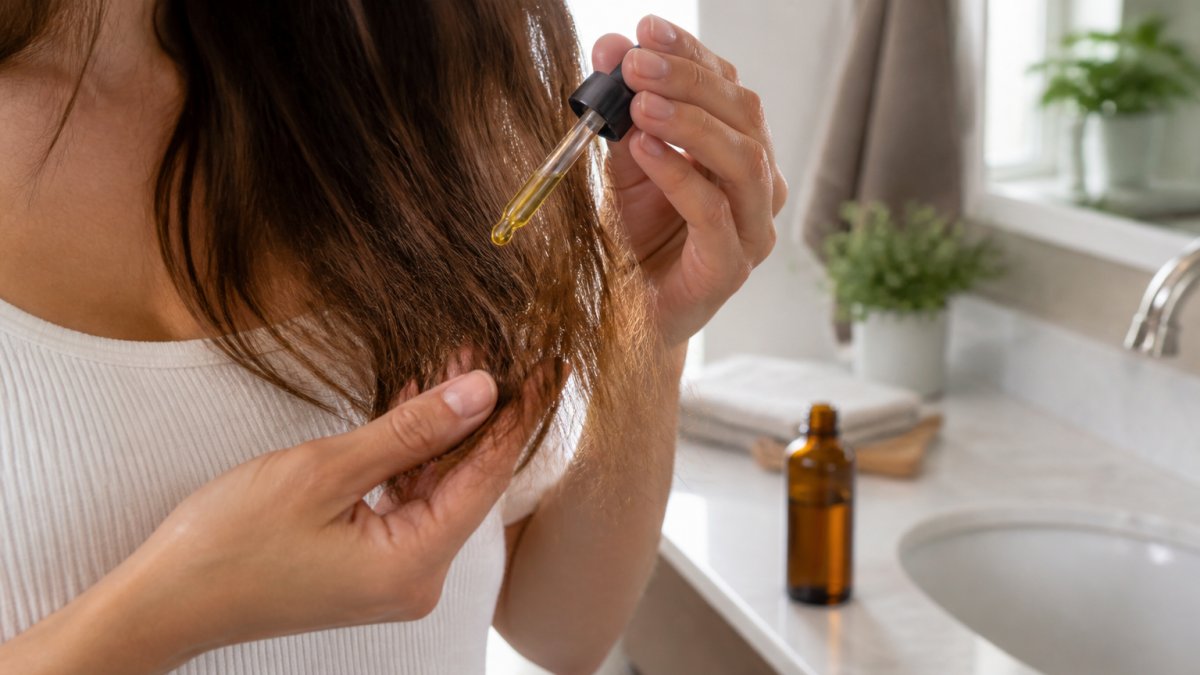
- Detangle dry hair first with a wide-tooth comb. Never oil tangled hair; you will snap strands.
- Warm two to three drops of oil between your palms. More is not better.
- Apply from mid-length to ends, avoiding the roots unless you are treating the scalp specifically.
- Massage the scalp for five minutes if using a diluted rosemary or peppermint blend.
- Leave it on for 30 minutes as a pre-shampoo treatment, or overnight with a silk cap for very dry hair.
- Shampoo with a sulfate-free cleanser and follow with a keratin-based conditioner.
- Finish with a lightweight serum on damp ends before styling.
Diluting Essential Oils Safely
Essential oils are concentrated and can burn or irritate the scalp when used neat. A safe working ratio is roughly one drop of essential oil to one teaspoon of carrier oil. If you are unsure, dilute more. Peppermint in particular can cause a strong cooling reaction that some people find uncomfortable.
Common Mistakes That Keep Brittle Hair Brittle
The biggest mistake is treating oil as a repair product rather than a protective one. Oil slows water loss and reduces friction, which prevents new damage. It does not rebuild broken bonds.
If your hair is still snapping after several weeks of consistent oiling, the damage has moved past what conditioning can address. That is the point where a professional keratin treatment, followed by a sulfate-free maintenance routine, makes the real difference. Our FIBERPLASTY SELF-HEATING OIL blends coconut, olive, shea, and macadamia oils with self-heating technology that helps nutrients reach the cortex, and it pairs directly with our keratin treatments for over-processed hair.

Brittle hair rarely improves from one product alone. It improves when you match the right oil to your porosity, stop expecting oil to do the job of a protein treatment, and protect the new growth you are trying to keep.
Frequently Asked Questions
What is the best oil for brittle, damaged hair?
There is no single winner, because brittle hair repair depends on your porosity and texture. Coconut oil penetrates the hair shaft and reduces protein loss, making it a strong choice for medium to thick strands. Argan oil adds shine and softness without weight, which suits fine or low-porosity hair. Avocado oil works well for coarse, dry hair that needs deep conditioning. Many people get the best results by layering a penetrating oil first and a sealing oil on the ends.
How often should you oil brittle hair?
For most people, a full pre-shampoo oil treatment once or twice a week is enough. Lighter oils, like argan or a finishing spray, can be used daily on dry ends without buildup. If your scalp is oily, keep the oil on your mid-lengths and ends rather than the roots. Over-oiling can weigh hair down and attract dust, so start with one weekly treatment and adjust based on how your hair feels.
Should you apply hair oil to wet or dry hair?
It depends on the oil and the goal. Penetrating oils like coconut and olive oil work best on damp or dry hair before shampooing, since water can block some absorption. Sealing oils and serums, such as argan oil, are usually applied to damp hair after washing to lock in moisture, or to dry ends for a quick shine boost. Self-heating oils are applied to wet hair because they need water to activate.
Can natural oils make brittle hair stronger?
Natural oils can improve elasticity, reduce friction, and help prevent split ends from worsening, which makes hair feel stronger and break less. What they cannot do is fuse a split end back together or speed up growth on their own. Think of oils as protection and conditioning, not structural repair. Pairing them with gentle washing, less heat, and regular trims gives you the most noticeable improvement.
Can coconut oil help prevent hair breakage?
Yes. Coconut oil is one of the few oils shown to penetrate the hair shaft, and research on hair protein loss found it can reduce damage during washing and styling. That makes it useful as a pre-shampoo treatment for brittle, over-processed hair. Apply it to dry hair 30 minutes to overnight before washing, then shampoo gently. If your hair feels crunchy afterward, you may be using too much or leaving it on too long.