
Table of Contents
- Why Silk Pillowcases Matter for Hair Health
- Silk vs Satin Pillowcase for Hair: What's the Real Difference?
- Moisture Retention and Hydration: How Silk Keeps Hair Balanced
- Preventing Hair Breakage While Sleeping: Practical Steps
- Preventing Hair Breakage While Sleeping: Practical Steps
- How to Wash Silk Pillowcases Without Damaging the Fibers
- Choosing the Right Silk Pillowcase for Your Hair Type
- Conclusion: Making Silk Work for Your Hair Routine
- Frequently Asked Questions
Last Updated: September 14, 2026
Why Silk Pillowcases Matter for Hair Health
Silk pillowcases are a smooth-fiber bedding option that reduces overnight mechanical friction, helping preserve the hair cuticle and retain moisture. This guide from Kerarganic Cosmetics, LLC breaks down what silk does for your hair and how to build a routine around it.
Most guides treat silk as a luxury upgrade when it's really a friction-control tool. Your hair spends roughly a third of your life against a pillowcase, and if that surface grabs and pulls, you pay in split ends, frizz, and stalled growth.
The Friction Problem with Cotton
Cotton is absorbent and textured, great for towels, terrible for hair. Its fibers grip the cuticle and wick away sebum, the natural oil that keeps strands supple.
That causes two problems at once: friction roughens the cuticle, so hair tangles more and reflects less light, while moisture loss leaves it brittle and breakage-prone. Textured or over-processed hair shows it most in the morning: more tangles, frizz, and shedding on the pillow.
Silk vs Satin Pillowcase for Hair: What's the Real Difference?
Silk is a natural protein-based fiber from silkworms, while satin is a weave structure that can be made from silk, polyester, or other fibers. A "satin pillowcase" may be synthetic, and synthetic satin generates static and heat buildup against your hair.
So the useful comparison isn't silk versus satin. It's silk versus synthetic satin.
| Feature | Mulberry Silk | Synthetic Satin (Polyester) |
|---|---|---|
| Fiber type | Natural protein-based | Manufactured polymer |
| Breathability | High | Lower, traps heat |
| Static buildup | Minimal | Common |
| Moisture handling | Balances without over-absorbing | Can repel moisture, feel clammy |
| Best for | Frizz-prone, dry, or damaged hair | Budget buyers, occasional use |
A genuine mulberry silk pillowcase with a tight weave gives the smooth surface and breathability you're after; polyester satin looks similar but behaves differently against hair.
Moisture Retention and Hydration: How Silk Keeps Hair Balanced
Silk's moisture behavior comes down to fiber chemistry. Silk fibroin is a protein built from amino acids with polar side groups, serine, aspartic acid, glycine, that bind water vapor from the air, making silk hygroscopic: it absorbs and releases moisture without feeling wet. Cotton cellulose does the same thing far more aggressively, and that difference matters for hair.
In plain terms: your hair and scalp give off water vapor overnight, and a hygroscopic surface reaches equilibrium with the air rather than pulling liquid from your strands. Cotton's wicking structure draws liquid water along the fiber, competing with your hair for the water in your sebum-and-water film. Silk competes far less.
A few practical numbers help frame this:
- Silk's typical moisture regain sits at roughly 9 to 11 percent of its dry weight at standard indoor humidity (fpl.fs.usda.gov). Cotton's is commonly cited around 7 to 8.5 percent but with much faster wicking and a rougher surface that lifts the cuticle.
- Silk's low thermal conductivity holds a stable microclimate against your head instead of cycling hot and cold like synthetic satin.
- Because silk does not wick aggressively, sebum stays closer to where it was produced rather than migrating down the strand or into the pillowcase.
Sebum is your scalp's built-in conditioner and a barrier that slows water loss from the hair shaft. When a pillowcase strips it, you get drier ends and a scalp that overproduces oil to compensate, hence greasy roots and parched ends after a night on cotton.
What This Means for Hair Elasticity
Hair elasticity, a strand's ability to stretch and return to shape, depends on water inside the cortex and the hydrogen bonds between keratin chains. Too little water and the strand is brittle; too much and the cortex swells, lifting the cuticle. Silk's buffered moisture exchange keeps you closer to the middle of that range than cotton or synthetic satin.
Test it yourself: run the back of a fingernail down a single wet strand. If it stretches and springs back, moisture balance is healthy. If it snaps with almost no give, the cortex is dehydrated, and the surface you sleep on is one of the easiest variables to change.
The Scalp Side of the Equation
Scalp health and hair hydration are linked. A pillowcase that traps heat and moisture, as synthetic satin tends to do, creates a warm, humid environment that can aggravate flaking and itching. Silk's breathability and low thermal conductivity keep the scalp cooler and drier at the surface while still preventing cotton's aggressive moisture pull, often more noticeable on a flaky or reactive scalp than any change in the hair shaft.
Preventing Hair Breakage While Sleeping: Practical Steps
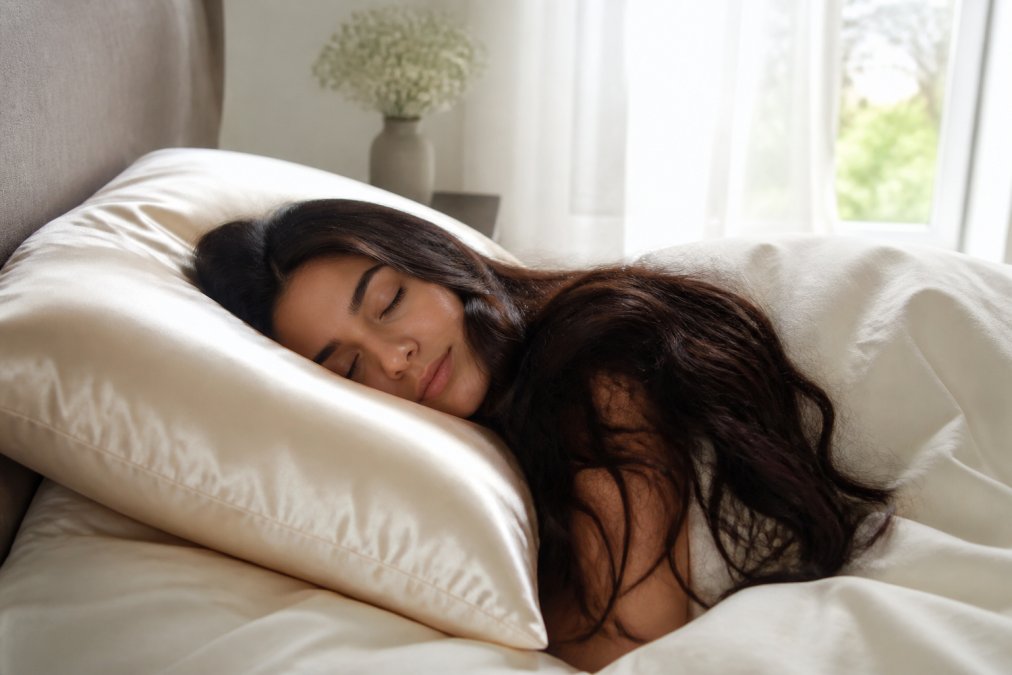
Preventing hair breakage while sleeping comes down to reducing friction, controlling tension, and supporting moisture balance before you lie down. None of these steps is complicated, but skipping them undoes much of what a silk pillowcase provides.
Start with these habits:
- Loose braid or bun: A single loose braid keeps strands contained without pulling at the root. Avoid tight styles that stress the hairline.
- Silk scrunchie, not elastic: Metal-free and fabric-covered ties reduce snagging at the mid-shaft.
- Dry hair before bed: Hair is most fragile when wet. Sleeping on damp hair stretches strands and encourages breakage.
- Brush before bed, not in the morning: Detangling while dry and calm prevents the tugging that morning brushing causes.
- Rotate your pillowcase every few nights: Oils and product residue build up on the fabric and reduce its smoothness.
Pairing Silk with the Right Overnight Products
The right overnight product amplifies what silk does. A lightweight oil or serum applied to the ends before bed seals in moisture and adds slip, so hair glides across the pillowcase instead of catching. Beyond surface-level hydration, incorporating copper peptides for hair into a nightly routine can further support follicle health and structural integrity while you rest.
For over-processed or frizz-prone hair, guidance from the American Academy of Dermatology on hair care notes that gentle handling and moisture retention are central to preventing further damage. Look for formulas built on plant oils and ceramides rather than heavy silicones. Kerarganic Cosmetics, LLC's FIBERPLASTY BIOLAMINATING ANTI-FRIZZ SERUM is designed to laminate the hair fiber surface and keep cuticles aligned, which pairs well with a silk surface. Apply two to three drops to damp ends, then let hair dry before sleeping.

Preventing Hair Breakage While Sleeping: Practical Steps
Preventing hair breakage while sleeping comes down to reducing friction, controlling tension, and supporting moisture balance before you lie down. None of these steps is complicated, but skipping them undoes much of what a silk pillowcase provides.
Start with these habits:
- Loose braid or bun: A single loose braid keeps strands contained without pulling at the root. Avoid tight styles that stress the hairline.
- Silk scrunchie, not elastic: Metal-free and fabric-covered ties reduce snagging at the mid-shaft.
- Dry hair before bed: Hair is most fragile when wet. Sleeping on damp hair stretches strands and encourages breakage.
- Brush before bed, not in the morning: Detangling while dry and calm prevents the tugging that morning brushing causes.
- Rotate your pillowcase every few nights: Oils and product residue build up on the fabric and reduce its smoothness.
Pairing Silk with the Right Overnight Products
The right overnight product amplifies what silk does. A lightweight oil or serum applied to the ends before bed seals in moisture and adds slip, so hair glides across the pillowcase instead of catching.

For over-processed or frizz-prone hair, guidance from the American Academy of Dermatology on hair care notes that gentle handling and moisture retention are central to preventing further damage. Look for formulas built on plant oils and ceramides rather than heavy silicones. Kerarganic Cosmetics, LLC's FIBERPLASTY BIOLAMINATING ANTI-FRIZZ SERUM is designed to laminate the hair fiber surface and keep cuticles aligned, which pairs well with a silk surface. Apply two to three drops to damp ends, then let hair dry before sleeping.
How to Wash Silk Pillowcases Without Damaging the Fibers
How to wash silk pillowcases correctly is the difference between a case that lasts years and one that loses its smooth finish in months. Silk is a protein fiber, and the same things that damage hair, heat, harsh detergents, and rough agitation, damage it.
Follow this routine:
- Hand wash in cool water with a pH-neutral detergent made for silk or delicates
- Skip fabric softener and bleach entirely; both break down the fiber
- Never wring or twist; press water out gently between two towels
- Air dry flat or hang away from direct sunlight
- If machine washing, use a mesh bag on the delicate cycle and cold water only
Wash every one to two weeks if you use oils or serums at night; residue dulls the surface and reduces the friction benefit you paid for.
Choosing the Right Silk Pillowcase for Your Hair Type
The right silk pillowcase depends on your hair's porosity, texture, and density more than on thread count marketing. Most buying guides stop at "silk is good for hair" and never tell you which silk, for which hair.
Match the Case to Your Texture
Type 4C coily hair. Tightly coiled strands have the fewest cuticle layers aligned along the length, making them the most vulnerable to friction and the most rewarding to protect. A 22-momme charmeuse weave gives the smoothest surface and least snag on coil clusters. Pair it with a satin-lined bonnet or a loose pineapple set with a silk scrunchie so coils aren't compressed against the pillowcase. The goal is zero tension on the hairline, where traction damage shows up first.
Type 3 curly hair. Curls lose definition when the cuticle roughens, because rough cuticles catch on each other and collapse the curl pattern. A 19-momme silk case preserves definition overnight better than any other bedding surface. Use a lightweight leave-in or curl cream, not a heavy oil, so the curl isn't weighed down before it sets.
Type 2 wavy hair. Waves are the most sensitive to humidity and compression. Silk reduces the friction that turns waves into frizz, but the bigger win is that it doesn't wick moisture like cotton, so the wave pattern holds its shape instead of relaxing flat against the pillow.
Type 1 straight and fine hair. Fine hair benefits mainly from reduced static and less breakage at the ends, not curl preservation. A 19-momme case is plenty; 22 momme can feel heavy and warm if you sleep hot. If your roots tend oily, choose a lighter momme and wash more often, since fine hair shows residue faster than coarse hair.
The Material Science Most Guides Skip
"Silk" and "satin" are not the same thing, and the confusion costs consumers money.
- Mulberry silk is a protein fiber from the cocoons of the Bombyx mori silkworm, which feed on mulberry leaves. Look for "100% mulberry silk" on the label, not "silk-like" or "silky."
- Satin is a weave structure, not a fiber, and can be woven from silk, polyester, nylon, or blends. A polyester satin pillowcase has a smooth surface, but it is a petroleum-based polymer with low breathability and a tendency to build static, the opposite of what frizz-prone hair needs.
- Charmeuse is a specific satin-weave silk with a shiny face and dull back, the most common weave in silk pillowcases and the best combination of smoothness and drape.
- Habotai is a lighter, plainer silk weave: cheaper but less durable and less smooth, so a poor choice for nightly hair protection.
A useful rule: if the price is under roughly what a comparable cotton pillowcase costs, it is almost certainly polyester satin, not silk. Real mulberry silk at 19 momme or higher carries a material cost a synthetic cannot match.
Specifications That Actually Matter
- Momme weight: 19 to 22 is the practical range for durability and feel. Momme measures silk density by weight; anything under 16 feels lovely in the store and wears thin within months. Above 25, the fabric becomes stiff and less breathable.
- Weave: A tight charmeuse or satin weave gives the smoothest surface. A loose weave snags more easily and loses its friction advantage faster.
- Certification: Look for OEKO-TEX Standard 100 or similar third-party testing if you have sensitive skin or allergies. Silk is naturally hypoallergenic, but dyes and finishes can still cause irritation.
- Construction: A hidden zipper or envelope closure keeps the pillow from sliding out and reduces the chance of metal hardware catching your hair.
The Sustainability Angle
Silk production has a real environmental footprint. Conventional silk farming requires mulberry cultivation, water, and the boiling of cocoons, and the fiber is not vegan. On the other hand, silk is biodegradable and, cared for properly, lasts for years, offsetting some production impact. Polyester satin is cheaper but is a petroleum product that sheds microplastics in the wash and does not biodegrade. If sustainability matters, choose a durable, certified silk case you keep for years rather than replacing annually.
A pillowcase that works beautifully for thick, curly hair may feel excessive to someone with fine, oily roots. Match the case to your hair, not to the trend.
Conclusion: Making Silk Work for Your Hair Routine
Silk pillowcases handle the friction and moisture side of overnight hair care, but they can't compensate for hair that's already damaged and needs rebuilding.
At Kerarganic Cosmetics, LLC, we build formaldehyde-free keratin treatments and restorative serums that rebuild strength in over-processed hair, eliminate frizz, and extend the results of salon smoothing services. Used alongside a silk pillowcase and a consistent overnight routine, they help you wake up with smoother, stronger, easier-to-style hair.
Get started with Kerarganic Cosmetics, LLC and give your hair the support it needs from wash day through the morning.
Frequently Asked Questions
Are silk pillowcases actually better for your hair?
Yes. Silk's smooth surface creates less friction than cotton, which means less rubbing against the hair cuticle during sleep. That friction reduction helps prevent split ends, breakage, and frizz. Silk also absorbs less moisture than cotton, so your hair's natural oils and any leave-in treatments stay on your strands instead of soaking into the pillowcase. The result is smoother, more hydrated hair in the morning, especially for anyone with dry, brittle, or over-processed hair.
Is there a difference between silk and satin pillowcases for hair?
The key difference is fiber versus weave. Silk is a natural protein-based fiber. Satin is a weave pattern that can be made from silk, polyester, or other materials. A satin pillowcase made from polyester may feel smooth but can still generate static and trap heat. A silk satin pillowcase combines the gentle protein fiber with a smooth satin weave, giving you the friction and moisture benefits people search for when comparing silk vs satin pillowcase for hair.
How often should a silk pillowcase be washed?
Wash your silk pillowcase every three to four days if you use leave-in oils, serums, or overnight treatments. Otherwise, once a week is enough. Use a gentle detergent formulated for delicates, cold water, and a mesh laundry bag. Skip the dryer; lay it flat or hang it to air dry. Rotating two pillowcases makes this schedule easier and extends the life of each one. Proper washing keeps the silk fibers smooth and protects your hair from buildup.
Does silk prevent hair breakage while sleeping?
Silk reduces the friction that causes breakage, but it works best as part of a routine. Pair a silk pillowcase with a loose braid or bun to limit tossing and tangling. Apply a lightweight serum or oil to your ends before bed to add slip and moisture. Kerarganic's Fiberplasty Biolaminating Anti-Frizz Serum, for example, helps seal cuticles and keep fibers aligned overnight, so you wake up with less breakage and fewer tangles.