

Quick Summary
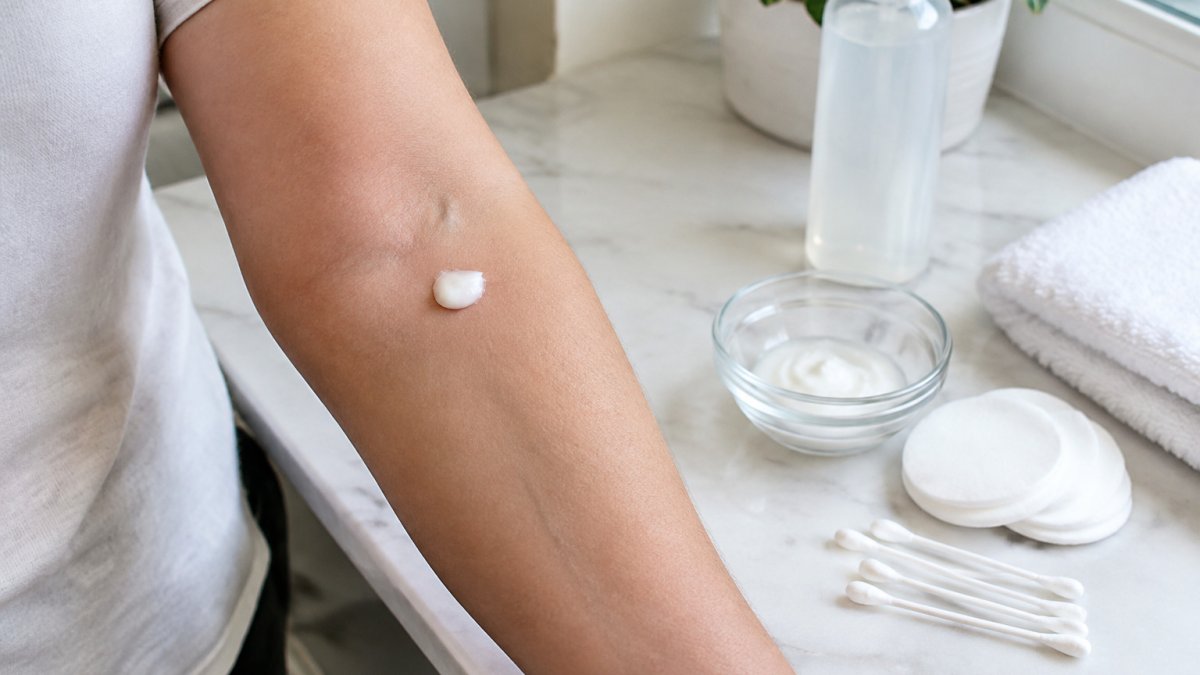
A keratin patch test checks whether your skin reacts to a keratin treatment product before you use it on your hair. Apply a dime-sized amount to a small hidden patch, such as the inner elbow or behind the ear, and leave it undisturbed. Check the site at 48 hours, then again at 4 and 7 days, for redness, itching, or swelling.
- Read the ingredient label first and note any actives or preservatives you have reacted to before.
- Apply about the size of a dime, spread thin, and do not rub it in.
- Do not wash the test area for 48 hours.
- Check the site at 48 hours, 4 days, and 7 days, photographing it under the same lighting.
- A clear home patch is one data point, not a full clearance, and delayed reactions can appear later.
Table of Contents
- What a Keratin Patch Test Checks For
- How to Perform a Keratin Patch Test at Home
- Where to Apply a Hair Treatment Patch Test
- How Long to Wait After a Hair Treatment Patch Test
- How to Know If a Hair Product Patch Test Is Positive
- When to Stop Use and Seek Medical Attention
- Booking Your Keratin Treatment After a Clear Test
- Frequently Asked Questions
What a Keratin Patch Test Checks For
Last Updated: November 4, 2026
A keratin patch test checks whether your skin reacts to a keratin treatment product before you use it on your hair. It is a simple way to catch an allergic response on a small area first. Most reactions show up as redness, itching, or swelling where the product touched the skin.
Keratin treatments contain ingredients that can irritate sensitive skin, and reactions do not always appear right away. That is why a patch test matters. Clinical patch testing typically leaves a substance on the skin for 48 hours before the first reading, according to Cleveland Clinic guidance on contact dermatitis testing.
The test looks for two kinds of problems:
- Immediate irritation: burning, stinging, or redness within minutes to hours
- Delayed allergy: itching, bumps, or rash that appears one to several days later
Keratin patch test is the term for this home check, done on a small patch of skin before a full hair application.
How to Perform a Keratin Patch Test at Home
A keratin patch test is only as reliable as the way you run it.
- Read the ingredient label first. Check the ingredient label for any straightening actives or preservatives you have reacted to before, and note them.
- Mix a small batch exactly as the label directs. Do not eyeball the ratio. The active-to-neutralizer ratio is what determines how much reactive ingredient contacts your skin, and a wrong mix can either mask a reaction or cause a false irritation.
- Start the clock at the moment of application. Write down the application time.
- Choose a small, hidden patch of skin. The inner elbow or behind the ear works. Clean with mild soap and water and dry fully, moisture under a patch can cause maceration that looks like a rash.
- Apply about the size of a dime and spread it thin. Do not rub it in. Leave it uncovered unless your product instructions say otherwise.
- Do not wash the area for 48 hours. Water, shampoo, and sweat all shorten the exposure and can wash away the very ingredients you are testing.
- Check at 48 hours, then again at 4 and 7 days. Photograph the site at each check under the same lighting so you can compare.
Watch out: Use a fresh amount of product for the patch test rather than leftover product.
Preparing the Test Site
Pick an area you can watch easily and rarely rub or wash. Keep it clean and dry before application. Avoid sun exposure on the test site; clinical protocols often ask patients to keep test areas out of direct sun for roughly two weeks beforehand, according to ScienceDirect practical guide to clinical patch testing. Do not apply lotion, oil, or sunscreen to the site on the day of the test, because an occlusive layer can concentrate the product and inflate the reaction.
Applying the Product and Starting the Clock
Apply a thin film and record the time. Starting the clock matters because you will use that timestamp to judge whether a reaction is immediate (minutes to hours) or delayed (one to several days). Keep a simple written log: mix time, application time, each check time, and what you saw. If you later react during a full application, that log is the first thing a dermatologist will ask for.
Why a Home Test Can Miss a Real Allergy
A negative home patch is not proof of safety, and keratin products are a common source of false negatives. Three things go wrong most often:
- Too little product or too short an exposure. A dime-sized spot washed off early may never deliver enough reactive ingredient to trigger a visible response.
- The reaction is delayed past the check window. Formaldehyde-type sensitization can take several days to surface, so a single 48-hour reading can miss it.
- The scalp behaves differently from the arm. Scalp skin is thicker, more sebaceous, and covered by hair, so a product that stays quiet on the inner elbow can still sting or inflame the scalp during a full treatment.
If you have reacted to hair smoothing products, hair dye, or nail products before, treat a clear home patch as one data point, not a clearance. A dermatologist can run a formal patch test with standardized allergens, including formaldehyde and related preservatives, under controlled conditions.
The steps below summarise the home patch test process, with the timing for each step.
| Step | What to do | Time or frequency |
|---|---|---|
| Read the label | Check for actives and preservatives you have reacted to | Before mixing |
| Mix the batch | Follow the label ratio exactly | Before application |
| Start the clock | Record the application time | At application |
| Choose a site | Inner elbow or behind the ear, clean and dry | Before application |
| Apply | About the size of a dime, spread thin, do not rub in | At application |
| Keep it dry | Do not wash the area | 48 hours |
| Check the site | Photograph under the same lighting | 48 hours, 4 days, 7 days |
Where to Apply a Hair Treatment Patch Test
The inner elbow and the area behind the ear are the two most common choices. Both have thin skin, which helps you spot redness quickly. Avoid broken skin, areas with rashes, and spots that you shave often.
How Long to Wait After a Hair Treatment Patch Test
Wait at least 48 hours before you decide the test is clear. For guidance on swimming after your full treatment, see when you can swim after keratin. Many people check again at 7 days, because some reactions are slow to show. Clinical readings are often taken at 2 and 4 days, with some protocols extending up to 7 days, according to European Society of Contact Dermatitis allergy testing guidelines(https://pmc.ncbi.nlm.nih.gov/articles/PMC13441402/).
ORGANIC KERATIN SYSTEM - STEP 2 - FORMALDEHYDE FREE →
Do not skip the wait. A product that looks fine on day one can still cause a reaction on day three.
How to Know If a Hair Product Patch Test Is Positive
Reading a patch test is a judgment call, and the difference between a positive result and a false alarm matters. A positive test means your skin reacted to the product. Look for changes in the test area that were not there before you applied it, and compare against the untreated skin next to it.
Signs of an Allergic Reaction to Watch For
- Redness that spreads beyond the test spot
- Itching, burning, or stinging that persists after you rinse the area
- Small bumps, blisters, or fluid-filled spots
- Swelling around the patch
- A rash that appears at 4 to 7 days rather than immediately
Irritation Versus Allergy: How to Tell Them Apart
Most reactions to keratin products fall into one of two buckets, and they call for different responses.
Irritant contact dermatitis is a direct chemical injury. It usually shows up within minutes to hours, stays confined to where the product touched the skin, and feels like burning or stinging more than itching. A strong straightening active left on thin skin too long can cause this even in people who are not allergic.
Allergic contact dermatitis is an immune response. It often appears 24 to 72 hours after exposure, can spread beyond the application site, and tends to itch more than it burns. Once sensitized, you can react to smaller amounts each time, which is why a reaction that was mild on the first treatment can be severe on the third.
A practical rule: irritation fades when the product is removed and the skin is washed; allergy can keep spreading for days after the product is gone.
The Keratin-Specific Reaction to Watch For
Keratin smoothing treatments are not a single ingredient, and formaldehyde is one of the common contact allergens in personal care products. The reaction pattern is distinctive: redness and itching that appear a day or two after exposure, sometimes with tiny bumps along the hairline, behind the ears, or on the neck where runoff collects. If you have reacted to hair dye, nail hardeners, or permanent-press fabrics, your risk of reacting to a formaldehyde-releasing treatment is higher, and a home patch is worth doing before every new brand.
Why a Negative Result Doesn't Always Mean Safe
A clear patch does not guarantee that you will never react. Reactions can appear later, the way a product behaves on a small patch can differ from a full scalp application, and home tests catch obvious irritants better than subtle sensitizers. Home tests do not replace testing done by a professional, according to DermNet NZ on patch testing limits. If your patch is clear but you notice itching, scaling, or tenderness during or after the full treatment, stop and treat that as a signal rather than a coincidence.
When to Stop Use and Seek Medical Attention
Stop using the product right away if you notice swelling, blistering, or spreading redness. Seek medical care if you have trouble breathing, swelling of the face or lips, or a rash that covers large areas of your body. These signs can point to a serious allergic reaction.
Booking Your Keratin Treatment After a Clear Test
If your patch test stays clear for the full observation window, you can move forward with confidence. Our Organic Keratin System is formulated with argan oil and hydrolyzed keratin for smoothing and repair. For a more complete routine, the Organic Keratin Treatment is designed to deliver smooth, manageable hair at home.


Frequently Asked Questions
Can you do a keratin patch test at home?
Yes. A home patch test is the most practical way to check for a reaction before a full keratin treatment. Apply a small amount of the product to a discreet area such as the inner elbow or behind the ear, leave it undisturbed for 48 hours, and check it for redness, itching, swelling, or bumps. A home test cannot replace a clinical patch test from a dermatologist, but it is a useful first screen for most people.
How long should you wait after a keratin patch test?
Most hair treatment patch tests call for a 48-hour observation period, during which the test site should stay dry and undisturbed. Readings are typically taken over the following days, since some reactions appear later. Do not book a full keratin treatment until the test site has stayed clear for the full window. If you react during the test, wash the area gently and do not proceed with the treatment.
What does a positive keratin patch test look or feel like?
A positive reaction usually shows as redness, itching, a burning or stinging sensation, swelling, small raised bumps, or tiny fluid-filled blisters at the test site. Some reactions appear within hours, while others develop a day or more later. A reaction that spreads beyond the test area, or that includes blistering or intense pain, is a reason to stop use and contact a healthcare provider promptly.
Should you patch test every time you use a keratin treatment?
Many stylists and manufacturers recommend a patch test before the first treatment and whenever you switch to a different product, even from the same brand. Sensitivities can develop over time, so a test you passed last year does not guarantee a safe result today. If you have had a salon treatment in the past and are using a new product for maintenance, a fresh patch test is a sensible precaution.
