

Last Updated: November 4, 2026
Quick Summary
Salon ventilation for keratin and chemical hair treatments means local exhaust at each station, placed close to the client's head and breathing zone, plus makeup air so the room stays near neutral pressure. Exhaust should run before product goes on, and it should vent outdoors away from fresh-air intakes.
- Each treatment station needs its own exhaust, since general room ventilation is not enough.
- Position the hood close to the client's head and check airflow with a tissue at the start of each session.
- Run exhaust before the product is applied, not after.
- Balance exhaust with makeup air so the room stays near neutral to slightly negative.
- Vent exhaust outdoors and keep the discharge away from fresh-air intakes and windows.
Table of Contents
- Why Ventilation Matters During Keratin and Chemical Hair Treatments
- How Much Exhaust Airflow Each Station Needs
- OSHA Hair Salon Air Quality Standards and What They Mean for You
- Setting Up Source Capture Ventilation for Keratin Treatments
- Makeup Air, Recirculation and Keeping Fumes Out of the Breathing Zone
- Checking Airflow in a Windowless Suite or Rented Space
- Booking Your Next Treatment Only After the Room Passes These Checks
- Frequently Asked Questions
Why Ventilation Matters During Keratin and Chemical Hair Treatments
Keratin and chemical hair treatments release fumes that can build up fast in a closed room. Proper ventilation helps reduce exposure to chemical fumes in hair salons, and it supports the comfort and safety of both clients and staff.
The problem is that fumes do not stay near the bowl or the flat iron. They rise, drift and settle into the air people breathe for the rest of the shift. National Center for Biotechnology Information study on working conditions and health risk in hair salons has documented how chemical exposure affects salon workers over time, which is why ventilation is a health issue, not just a comfort issue.
Salon ventilation is the system that moves fresh air in and pulls contaminated air out. Done right, it helps keep indoor air quality acceptable during treatments, not just after them.
- Chemical fumes can spread beyond the station
- Staff often breathe the same air for hours
- Clients sit close to the treatment area for long periods
- Poor airflow makes every other safety step less effective
How Much Exhaust Airflow Each Station Needs
Each treatment station needs its own exhaust. General room ventilation is not enough when you are working with chemically heavy services. New York Department of State guidance on salon ventilation now emphasizes local exhaust at each station rather than relying only on room-wide air.
Ventilation requirements vary by room size, station count and local code, so confirm the binding minimums with your local building or mechanical authority.
These figures are starting points. Your room size, number of stations and treatment schedule all change the final number. A busy keratin day puts far more load on the system than a quiet color day.
OSHA Hair Salon Air Quality Standards and What They Mean for You
The Occupational Safety and Health Administration (OSHA) has addressed hair salon air quality directly. OSHA guidance on formaldehyde in hair products and salon air testing states that salons must test air quality during treatments to determine formaldehyde levels and provide adequate ventilation.
What this means in practice:
Our formulas are formaldehyde-free, but that does not replace airflow. Even low-emission products produce fumes during heating and application, so ventilation stays necessary.
Setting Up Source Capture Ventilation for Keratin Treatments
Source capture means catching fumes at the point where they are made. For keratin work, that means an exhaust hood or intake positioned close to the client's head and the stylist's breathing zone. A hood placed at the wall across the room will miss most of what matters.
A hair stylist working at a salon station with a wall-mounted exhaust hood positioned above the client's head during a keratin treatment.
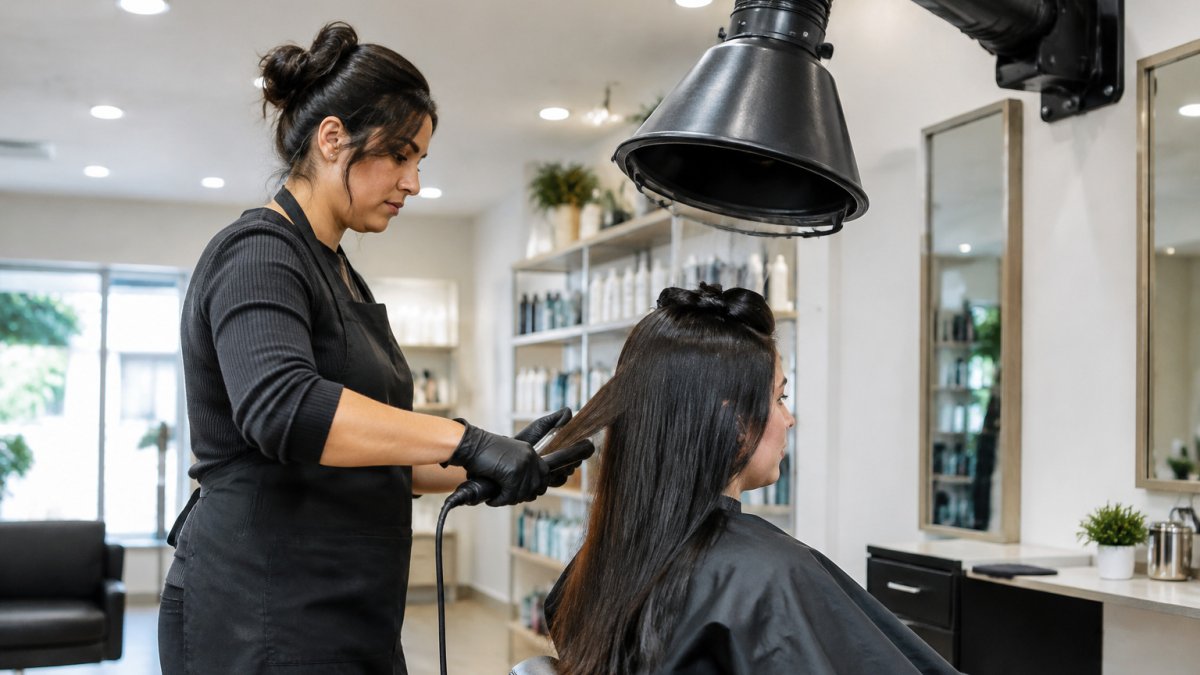
Start with the treatment steps. Our Organic Keratin System, Step 2 is applied from root to tip, then left to act for about 10 minutes. That application window is when fumes are most likely to rise, so the exhaust should be running before the product goes on.
Watch out: a hood that is running but angled away from the head captures very little. Check the position with a tissue or a lightweight strip at the start of each session.
For a full look at the product line, see our Organic Keratin System, Premium treatment and the guide to vegan hair care products for salons before you set up your room.

Source capture works best when the exhaust is positioned and timed around the treatment steps, as summarised below.
| Check | What to do | When |
|---|---|---|
| Hood position | Place exhaust close to the client's head and breathing zone | Before setup |
| Airflow test | Hold a tissue or lightweight strip at the hood | Start of each session |
| Exhaust timing | Run exhaust before the product goes on | Before application |
| Application window | Product is left to act for about 10 minutes | During treatment |
| Hood angle | Angle away from the head captures very little | Every session |
Makeup Air, Recirculation and Keeping Fumes Out of the Breathing Zone
Exhaust fans pull air out of the room. Makeup air brings fresh air back in to replace it. Without makeup air, the fan struggles, the room goes under negative pressure and air gets pulled in through gaps in ways you do not control.
ORGANIC KERATIN SYSTEM - STEP 2 - FORMALDEHYDE FREE →
Makeup air should be sized to match the exhaust you run, and a qualified mechanical professional can confirm the correct sizing for your room.
Recirculation is the other risk. If exhaust air is dumped back into the room or pulled back through a return vent, the fumes you removed come right back. Vent exhaust outside the building, and keep the exhaust discharge away from fresh-air intakes. A discharge that terminates near an intake, a window, or a neighboring suite's air handler can reintroduce fumes and odors into the space you just cleaned.
Pressure balance matters more than most owners realize. A room held strongly negative pulls air from adjacent suites, hallways, and restrooms, which can bring in odors and make doors hard to open. A room held positive pushes treatment fumes into neighboring spaces. The practical target is a slight negative pressure relative to surrounding spaces, enough to keep fumes contained without starving the exhaust.
- Balance exhaust and makeup air so the room stays near neutral to slightly negative
- Route exhaust outdoors, not into a ceiling plenum or return duct
- Keep the exhaust discharge away from fresh-air intakes and operable windows
- Keep the breathing zone between client and stylist clear of direct fumes
- Replace filters on the schedule the manufacturer gives
Heat-activated smoothing services can release fumes during the flat-iron pass, so keeping exhaust close to the treatment area during that step is a sensible precaution.
Watch out: a makeup-air unit that is undersized or interlocked incorrectly can cause the exhaust fan to short-cycle or run continuously without moving the rated airflow. Confirm equipment performance after installation with a qualified professional.
Checking Airflow in a Windowless Suite or Rented Space
Many salons work in windowless suites or rented spaces where you cannot change the building. You can still check your setup, document what you have, and make targeted fixes without a full mechanical renovation.
Start by confirming how your space is ventilated, and ask a qualified professional to help you estimate air changes per hour for your room.
Simple checks you can run yourself:
- Hold a light strip near the exhaust grille and confirm it pulls inward
- Note whether doors seal well and whether air is drawn under them
- Test air during a full treatment, not a quiet hour
- Ask your landlord for the mechanical specs before you sign or renew
- Confirm whether the building's exhaust runs during off-hours or only on a schedule
For a more reliable reading, a qualified technician can measure delivered airflow after the system has been running under treatment load.
If the numbers come up short, discuss options such as dedicated exhaust with a qualified professional. In a rented space, portable source-capture units and freestanding exhaust fans can bridge the gap while you negotiate a permanent fix with the landlord.
Landlord negotiation points worth raising in writing:
- Whether the lease assigns responsibility for exhaust maintenance and filter changes
- Whether you can install a dedicated exhaust fan and a makeup-air path
- Whether the building's exhaust schedule can be extended to cover treatment hours
- Whether the landlord will provide mechanical drawings or a commissioning report
Watch out: a windowless suite with no makeup-air path can go so negative that the exhaust fan stalls and fumes linger despite the fan running. If doors are hard to open or you feel air rushing in at the threshold, the makeup-air side needs attention before you add more exhaust capacity.
Booking Your Next Treatment Only After the Room Passes These Checks
Review your room's ventilation setup before scheduling treatments, and confirm that the exhaust and airflow arrangements are working as intended.
When the checks pass, the next step is choosing products you can trust in that room. Our vegan hair care products for salons buying guide walks through what to look for, and our Organic Keratin System, Premium treatment gives you a professional-grade option built for salon use. Ventilation and product choice work together. Get both right, and your next treatment day is safer for everyone in the room.
Frequently Asked Questions
Do hair salons require ventilation?
Yes. Chemical hair treatments release fumes that build up quickly in closed rooms, so salons need mechanical ventilation in addition to any windows. Ventilation requirements for salons are set by local building and mechanical codes, so confirm the specific minimums with your city or county building department. Your local building and mechanical codes set the binding minimums, so confirm them with your city or county building department.
What are the OSHA requirements for hair salons?
Employers have general obligations to protect workers from workplace hazards, and salon owners should review current federal and state workplace safety requirements that apply to their operation. Products listed as formaldehyde-free still need ventilation because other ingredients release vapors during heating and application.
What is the difference between general ventilation and source capture systems?
General ventilation moves air through the whole room, diluting contaminants after they have spread. Source capture, also called local exhaust, places an intake hood or fan at the treatment station so fumes are pulled away before they reach the stylist's or client's breathing zone. Many salon owners use local exhaust at each station alongside general room ventilation for chemically heavy treatments. Most salons doing keratin work benefit from both systems working together.
How often should salon ventilation filters be replaced?
Replace exhaust and recirculation filters on the schedule set by the equipment manufacturer, and check them more often in busy salons or where hair dust and product residue build up quickly. Follow the replacement schedule provided by your equipment manufacturer, and check filters regularly, especially in busy salons.
