
Last Updated: November 1, 2026
Quick Summary
Vegan hair care products for salons are professional formulas with no animal-derived ingredients and no animal testing, made for backbar and retail use. Match the shampoo to the service, confirm any vegan claim with a third-party certificate, and judge backbar products on cost per service rather than cost per bottle.
- Watch for keratin, lanolin, beeswax, carmine, shellac, and hydrolyzed silk, which disqualify a vegan claim.
- Vegan describes ingredients only, while cruelty-free describes testing, so a product can be one without the other.
- Ask for the certificate rather than the logo, confirm the scope covers the finished product, and re-verify annually.
- Calculate cost per service by dividing wholesale cost by the services a container delivers.
- Run a small trial of one liter each of shampoo, conditioner, and treatment before committing to case quantities.
Table of Contents
- What Makes a Hair Care Product Truly Vegan
- Vegan Salon Shampoo and Conditioner: Matching Formulas to Services
- Vegan Hair Products for Curly Hair: Texture and Curl Care
- Vegan Hair Styling Products: Sprays, Gels, Creams, and Pomades
- Cruelty-Free Professional Hair Products: Certification and Verification
- Backbar Performance and Salon Purchasing Economics
- Building Your Vegan Hair Care Retail and Backbar Order
- Frequently Asked Questions
What Makes a Hair Care Product Truly Vegan
Vegan hair care products for salons are professional formulas with no animal-derived ingredients and no animal testing, made for backbar and retail use.
Most "vegan" claims describe an absence, not a standard. No single federal definition exists for cosmetics, so two products can both say vegan and mean very different things.
A practical approach is to scan for animal-derived ingredients first, then check who tested the finished product, then read the first five ingredients after water.
Reading the Ingredient List Past the Front Label
The front label sells the client. The ingredient list tells you whether the product belongs in your salon.
Animal-derived ingredients hide under names that do not sound animal at all. Watch for keratin from hooves or feathers, lanolin, beeswax, carmine, shellac, and hydrolyzed silk.
Then look at the first five ingredients after water, where the surfactant system and primary conditioning agents sit in most shampoos and conditioners. A plant-based marketing line above a formula built on harsh sulfates will strip color-treated hair.
For a deeper walkthrough of decoding professional labels, see our guide on how to read professional hair product labels.
Vegan Salon Shampoo and Conditioner: Matching Formulas to Services
Match the shampoo to the service, not to the shelf.
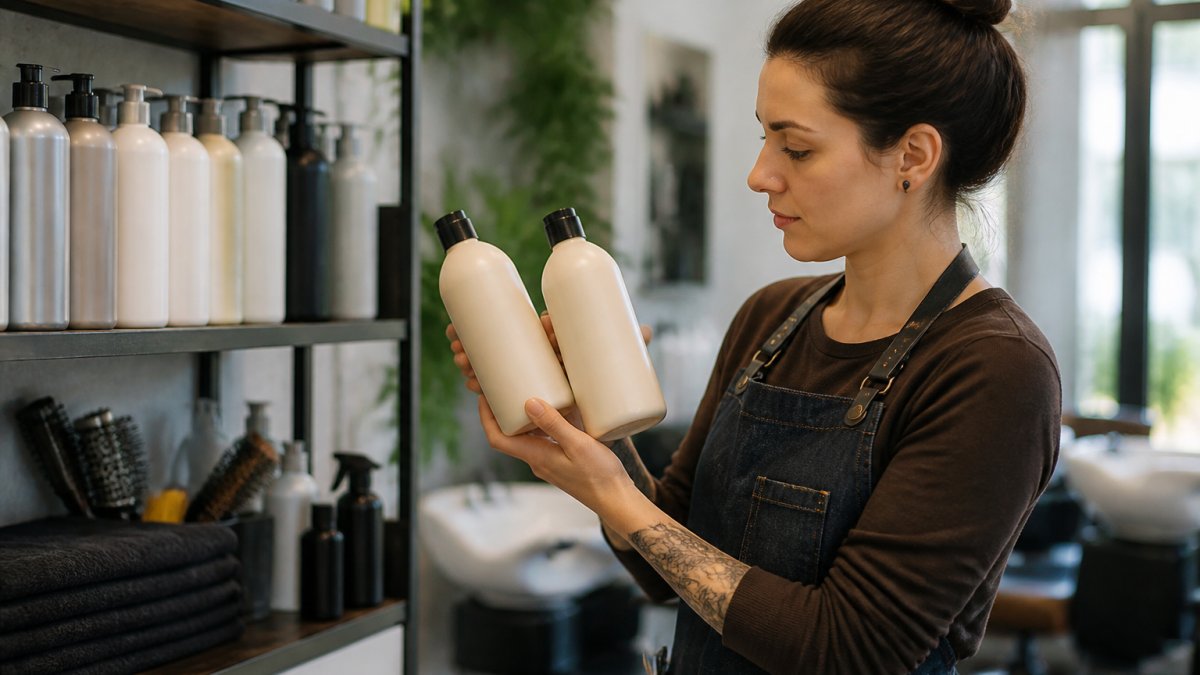
Vegan salon shampoo and conditioner selection comes down to three variables: surfactant strength, moisture level, and how the formula interacts with treatments already on the hair.
- Color-treated and gloss clients: sulfate-free cleansers and a conditioner with plant oils high in the list.
- Fine or low-density hair: lightweight conditioners that rinse clean; skip heavy butters near the root.
- Coarse or over-processed hair: a richer mask and a leave-in with protein support.
Stocking one shampoo and one conditioner for the whole salon works until a smoothing client and a fine-curls client sit in the same chair on the same afternoon.
Vegan Hair Products for Curly Hair: Texture and Curl Care
Vegan hair products for curly hair should prioritize humectants, plant-based oils, and a surfactant system gentle enough to preserve the curl pattern between washes.
What most guides miss is the interaction between smoothing treatments and curl memory.
For a focused breakdown by texture, our guide on which professional hair care products work for curly hair covers the product types that hold up in practice.
Vegan Hair Styling Products: Sprays, Gels, Creams, and Pomades
Styling is the category where vegan claims get tested hardest, because hold and finish are easy to feel and hard to fake.
Vegan hair styling products break into four working groups, each with a different job:
- Sprays: flexible hold and heat protection for finishing and setting.
- Gels: firm definition for curls and edge control, best applied to damp hair.
- Creams: moisture and smoothness for coarse or dry textures.
Read styling labels as carefully as shampoo. A vegan gel built on drying alcohol leaves curls crisp for the wrong reason; a cream listing a plant butter first will weigh fine hair down. The front label promises; the back label tells you what happens in the chair.
Cruelty-Free Professional Hair Products: Certification and Verification
Cruelty-free professional hair products carry a claim easier to verify than "vegan," because third-party programs publish their standards and brand lists. But the gap between a printed bunny logo and a documented audit is where most salon purchasing mistakes happen. Navigating these verification layers requires a discerning eye, which is why consulting a cruelty-free product guide helps stylists distinguish between mere marketing claims and verifiable ethical standards.
The two names a salon owner sees most are the Leaping Bunny program (administered by Cruelty Free International) and the Choose Cruelty Free standard. Both require a supplier-level audit rather than a self-declaration, which is why a certified product is worth more in a client conversation than a bottle printing "not tested on animals." An audit costs the brand money and time, which is why it carries weight.
Vegan vs. Cruelty-Free vs. Plant-Based: Four Different Claims
Salon staff routinely use these terms interchangeably. They are not interchangeable, and a client who asks a direct question will expose the difference.
- Vegan describes ingredients: no animal-derived components in the finished formula. It says nothing about testing.
- Cruelty-free describes testing: no animal testing at any stage. It says nothing about ingredients, a cruelty-free formula can still contain lanolin or beeswax.
- Plant-based describes sourcing emphasis, usually a percentage of plant-derived content. It is a marketing descriptor, not a standard, and does not exclude synthetics.
A product can be vegan but not cruelty-free, cruelty-free but not vegan, or both. The strongest position for a salon is a line that holds both claims with third-party certification behind each.
A Practical Verification Checklist
Before a line enters your backbar, run this sequence. It takes about fifteen minutes per brand and saves months of awkward client conversations.
- Ask for the certificate, not the logo. A recognized certification comes with a certificate naming the brand and covered product range. If the supplier can only point to a website badge, treat the claim as unverified.
- Confirm the scope. Does the certification cover the finished product you are buying, or only selected ingredients or a parent company's legacy line? Scope mismatches are common.
- Request the ingredient declaration. For a vegan claim, ask the brand to confirm no animal-derived ingredients, and specifically ask about the protein source, keratin, silk, and collagen are the usual culprits.
- Ask about supplier testing. A finished product can be untested while a raw-material supplier tests components. The audit standard should address this; a self-declaration usually does not.
- Document the date. Certifications lapse and brands change ownership. Note the certificate date and re-verify annually.
What to Tell Clients in One Sentence
Staff training on this topic is usually overcomplicated. The workable script is short: "This line is certified cruelty-free by an independent auditor, and the formula contains no animal-derived ingredients, here is the certificate if you would like to see it." That sentence is defensible because it is specific.
For a deeper walkthrough of what each certification program actually requires, see our breakdown of essential certifications for professional hair stylists.
Backbar Performance and Salon Purchasing Economics
Backbar economics are where vegan positioning either pays for itself or quietly costs you money. A professional liter that underperforms in dilution ratio or coverage per service erases any retail margin it earns.
Cost Per Service, Not Cost Per Bottle
Judge a backbar product on cost per service. The calculation is straightforward:
- Note the wholesale cost of the container (for example, a 1-liter shampoo).
- Measure how many client services that container delivers at your standard application, count pumps or pours across ten services, then average.
- Divide wholesale cost by services delivered.
A formula that needs a heavier pour to feel like it is working costs more than its shelf price suggests. Two liters at the same wholesale price can differ by 30 percent in cost per service if one lathers and rinses with half the product. Run the count on your own chairs, not on the brand's claim.
Wholesale Access, Minimums, and Refill Options
Professional lines typically sell through wholesale accounts with minimum opening orders and case quantities. Before committing, ask three questions:
- What is the minimum opening order, and does it lock you into a product mix? A low minimum with flexible mix is worth more than a discount that forces you to stock slow movers.
- Are refill or bulk sizes available? Refill formats for backbar reduce packaging cost per ounce and cut waste; they also reduce the retail shelf presence, so plan retail duplicates separately.
- What are the reorder terms? Freight thresholds and lead times affect your true landed cost. A slightly higher unit price with free freight at a low threshold often beats a lower unit price with shipping added.
Retail Margin and the Backbar Connection
Retail margin is retail price minus wholesale cost, expressed as a percentage. A common salon pattern is a margin that covers staff commission and still leaves profit after the client discount, most owners find a mid-range margin works, but the exact figure depends on your commission structure.
The strategic point is that the backbar and retail layers should share a formula family. When the backbar result is good, the retail duplicate sells at full margin with almost no selling effort.
Run a Small Trial Before a Case Buy
Buying a new line on a promotional case price before testing it across your top three services is the fastest way to tie up cash in product your stylists will not reach for. Run a small trial first: one liter each of shampoo, conditioner, and the treatment most relevant to your service mix, used across a defined number of clients. Track cost per service, client comments, and stylist preference before committing to case quantities.
Track usage by service type, not just by month. When you know which shampoo and conditioner pair moves fastest, reordering gets simpler and dead stock drops. Our guide on how to build a professional hair care inventory walks through the tracking methods that keep backbar spend predictable.
Building Your Vegan Hair Care Retail and Backbar Order
Build the order in two layers: the backbar formulas your stylists use every day, and the retail duplicates clients take home. The second layer only sells if the first layer delivered a result the client can feel.
Start with a narrow core:
- One sulfate-free shampoo and one matching conditioner for color-treated clients
- One richer mask for over-processed and coarse hair
- One curl cream or gel for textured clients
Then add depth where your client mix demands it. A salon with a strong smoothing service will want a keratin-support retail pair that protects the service between visits.
Staff training is the last piece, and the one most salons skip. For retail tactics that work alongside a backbar change, see our strategies for increasing salon retail sales.
| Decision | What to Check | Why It Matters |
|---|---|---|
| Shampoo and conditioner | Surfactant strength, first five ingredients | Protects color and treatment results |
| Curl care | Humectants and lightweight oils | Preserves pattern without weighing it down |
| Styling | Hold level and finish | Matches the service the client booked |
| Certification | Recognized cruelty-free certification | Backs the claim in a client conversation |
| Backbar | Cost per service, not per bottle | Controls real spend |
| Retail | Duplicates the backbar result | Drives repeat purchase |
The challenge is not finding vegan products.
Frequently Asked Questions
What makes a hair care product vegan?
A vegan hair product contains no animal-derived ingredients, which rules out things like honey, beeswax, lanolin, keratin from animal sources, and carmine. Plant-based proteins, oils, and surfactants replace them. The label alone is not proof, so check the full ingredient list and look for third-party vegan certification. For salons, this matters because clients ask, and a stylist who can point to a certification answers the question in seconds rather than guessing.
Are vegan hair products also cruelty-free?
Not automatically. Vegan refers to ingredients, while cruelty-free refers to testing on animals. A formula can be plant-based and still be tested on animals, and a cruelty-free brand can use honey or beeswax. Salons should look for both claims and verify each with a separate certification, since clients often assume the two go together. When you stock cruelty-free professional hair products, confirm the testing statement covers the finished product, not just the raw materials.
How can a salon check whether a hair care product is truly vegan?
Start with the full ingredient list, not the front label, and scan for honey, beeswax, lanolin, carmine, and animal-derived keratin. Then ask the supplier for a current certificate from a recognized vegan certification program and confirm it covers the specific SKU you are ordering. Request a batch or date reference so the certificate matches what ships. A supplier who cannot produce documentation on request is a supplier to skip when clients ask hard questions.
Are professional vegan hair products effective for damaged hair?
Plant-based proteins and oils can rebuild slip and reduce frizz on over-processed hair, and many salon lines now formulate them for color-treated and chemically straightened clients. Performance depends on the formula, not the vegan claim, so test on the backbar before retailing. Run a patch on two or three clients with different textures, compare shine and manageability after one week, and only then commit shelf space. Vegan certification says nothing about how a product performs on damaged hair.
