
Table of Contents
- Why Professional Hair Dryer Features Matter for Thick Hair
- Hair Dryer Wattage for Thick Hair: Power and Drying Speed
- Ionic Hair Dryer Technology for Thick Hair and Frizz Control
- Heat and Speed Settings: Finding the Right Balance
- Hair Dryer Attachments for Thick Hair: Concentrators and Diffusers
- How to Blow Dry Thick Hair Without Frizz: Technique and Product Pairing
- Protecting Thick Hair From Heat Damage During Styling
- Frequently Asked Questions
Last Updated: October 12, 2026
Why Professional Hair Dryer Features Matter for Thick Hair
A professional hair dryer thick hair demands requires a different approach to drying than fine or medium textures. Dense strands hold moisture longer, so the right professional hair dryer features for thick hair aren't conveniences, they're necessities. Standard consumer dryers often lack the power and precision to handle the volume without frizz, breakage, or an uneven finish.
At Kerarganic Cosmetics, LLC, we know thick hair requires tools engineered for performance. The difference between struggling for 45 minutes and achieving salon-quality results in 20 comes down to wattage, ionic technology, heat distribution, and attachments designed for density. Without these working together, you're fighting your hair's natural structure rather than working with it.
The stakes are real: over-drying causes brittleness and split ends, under-drying leaves frizz, and the wrong tool forces longer heat exposure that compounds damage. This guide breaks down which professional hair dryer features actually matter for thick hair and why.
Hair Dryer Wattage for Thick Hair: Power and Drying Speed
Wattage is the most misunderstood spec on a hair dryer box, and thick hair is where that costs you the most time. Drugstore dryers sit between 1,200 and 1,800 watts; professional dryers for thick hair start at 1,800 and climb past 2,000.
A dryer's motor spins a fan that pushes air through the barrel while the heater coil warms it. Wattage is split between motor and coil, and how a manufacturer divides that budget determines real-world performance.
For thick hair, airflow velocity matters because dense strands trap humid air against the scalp. Low airflow lets that pocket sit, so the surface dries while the interior stays damp.
How do you assess airflow without a lab? Three practical checks:
- Look for a CFM or airspeed figure. Some professional brands publish CFM; many don't. Airflow in miles per hour or feet per minute is more useful than wattage alone.
- Compare motor type. AC motors (common in salon dryers) produce stronger, more sustained airflow and last longer than DC motors at similar wattage, though they're heavier, a trade-off you'll feel during a 25-minute session.
- Test the feel. On high speed with heat off, a strong dryer pushes a visible stream of air across a room; a weak one barely moves a tissue held a foot away. Rough but reliable.
The payoff: if a low-airflow dryer takes 40 minutes on thick hair, a high-airflow professional dryer can bring that to 15-20. Less time under heat means measurably less cumulative damage, the real reason airflow matters more than the wattage badge.
A reasonable baseline for thick hair: 1,800 watts or higher, paired with an AC motor and a concentrator nozzle that narrows and accelerates the stream. If you can only verify one number, verify airflow, not wattage.
Ionic Hair Dryer Technology for Thick Hair and Frizz Control
Ionic technology is standard in professional dryers, but it works differently on thick hair than fine textures. Negative ions break water molecules into smaller droplets that absorb into the shaft faster, which matters because density traps moisture differently than fine strands.
Thick hair's cuticle layers are more tightly packed. Without ionic technology, water clings to the outer surface and creates frizz as it evaporates unevenly. Ionic dryers emit negative ions that neutralize the positive charge on water molecules, letting them penetrate the structure and evaporate from within, for a smoother, shinier finish with less frizz.
The key is consistent ion emission. Some budget dryers claim ionic technology but only activate it intermittently. Professional models maintain steady ion output throughout the drying cycle. When paired with leave-in conditioners, like Kerarganic's KERATIN LEAVE-IN CONDITIONER ULTRA MOISTURIZER, ionic technology amplifies the conditioning benefits by helping moisture penetrate deeper into each strand.

For thick hair, ionic technology is non-negotiable. Without it, you're fighting frizz at every step. With it, you're working with your hair's natural moisture absorption.
Heat and Speed Settings: Finding the Right Balance
Thick hair tolerates higher heat than fine hair, but tolerance isn't optimization. The real risk with dense hair is cumulative exposure during a long session: if drying takes 30 minutes, every extra minute at high heat compounds damage. The goal of heat and speed control is to shorten total heat exposure, not maximize temperature.
Professional dryers for thick hair typically offer 3-5 heat settings and 2-3 speed settings. Use heat strategically and airflow aggressively.
A workable sequence for thick hair:
- Start with medium-high heat and high speed to remove bulk moisture quickly. High airflow does the heavy lifting here; you do not need maximum heat to move water off the surface.
- Once hair is about 60-70% dry, drop to medium heat and medium speed. This prevents the outer layers from over-drying while the interior still holds moisture, the classic cause of a crispy exterior over a damp core.
- Finish with low heat (or cool) and high speed to seal the cuticle and lock in shine. Cool air at high speed is what creates smoothness without adding heat.
Speed settings matter as much as heat. High-speed air accelerates drying without extreme temperatures, which is why independent heat and speed controls are non-negotiable. Dryers that lock heat and speed into fixed combinations remove the flexibility to run cool air at high speed on the final pass.
Temperature consistency is the spec most buyers ignore. Inexpensive dryers cycle the heater on and off, producing hot spots that scorch one section while leaving another damp. Better dryers maintain steadier output, drying more evenly and reducing localized damage.
Practical damage-prevention habits for long sessions:
- Keep the nozzle 6-8 inches from the hair. Closer concentrates heat on one spot and raises surface temperature fast.
- Keep the dryer moving. Never hold it stationary; constant motion distributes heat and prevents hot spots.
- Section and clip. Working in 2-inch subsections exposes each area to heat for less total time. Re-drying already-dry hair is a common source of avoidable damage.
- Pre-dry with a towel or air. Removing surface moisture first can cut several minutes off the session.
- Always use a heat protectant. A leave-in with ceramides or silicones creates a barrier that buys margin during longer dry times.
If drying routinely exceeds 40 minutes for shoulder-length thick hair, the problem is usually airflow, not heat settings. No heat setting compensates for a dryer that can't move enough air.
FIBERPLASTY CUTICLE RESURFACING LEAVE-IN CONDITIONER →
Hair Dryer Attachments for Thick Hair: Concentrators and Diffusers
Attachments transform a professional hair dryer from a general tool into a precision instrument. For thick hair, concentrator nozzles are essential; diffusers are optional but valuable for specific styles.
A concentrator nozzle narrows airflow into a focused beam, directing heat and air precisely where you need it, reducing drying time and preventing the scattered, frizz-prone drying of bare airflow. Professional concentrators have internal baffles that shape and accelerate the stream, letting you target dense areas without wasting energy on surrounding space.
Diffusers spread air across a wider surface area, suiting thick, curly, or textured hair when you want volume without directional styling. They're less essential for sleek blowouts but invaluable for texture, waves, or curls with minimal frizz.
The best professional dryers include both. Concentrators should feel sturdy and fit snugly, loose attachments leak air and reduce efficiency. Check that the nozzle narrows airflow noticeably; a poorly designed concentrator barely improves on bare dryer performance.
How to Blow Dry Thick Hair Without Frizz: Technique and Product Pairing
The right tool means nothing without the right technique. Thick hair requires a deliberate drying sequence that respects its density and moisture content.
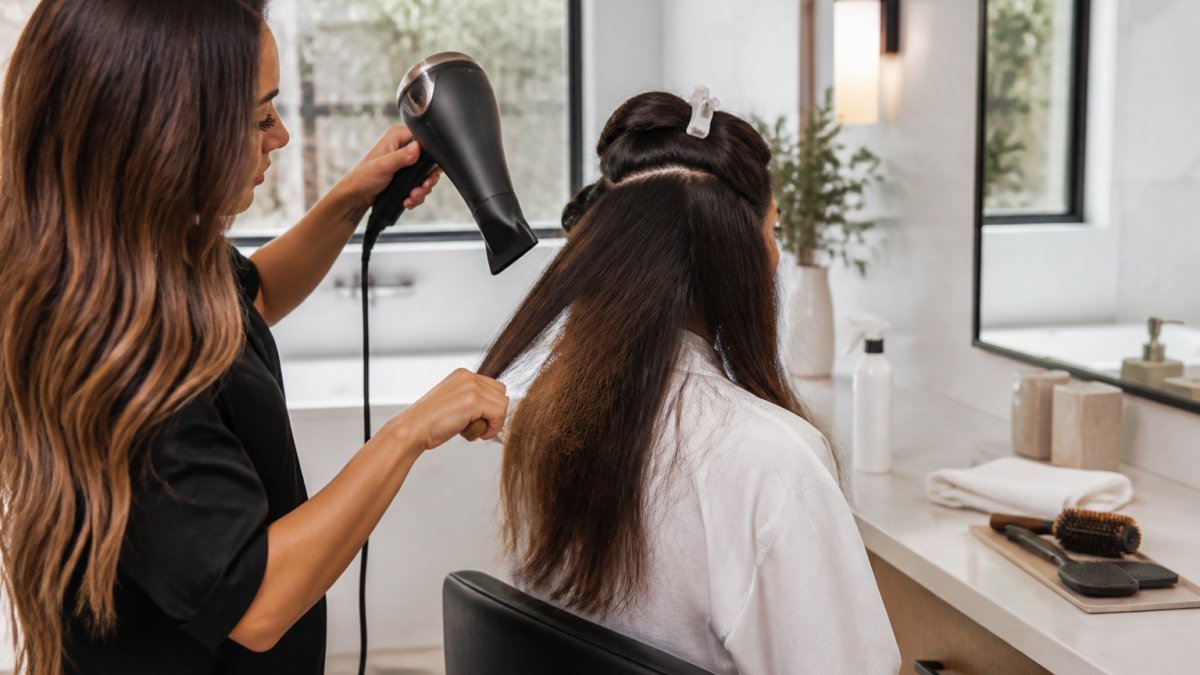
Start by applying a leave-in conditioner spray to damp hair. Products like Kerarganic's FIBERPLASTY CUTICLE RESURFACING LEAVE-IN CONDITIONER contain ceramides and heat protectors that prepare thick strands for drying. Spray generously, then comb through to distribute evenly.

Divide hair into four quadrants (two front, two back). Clip up three and work one at a time to avoid re-drying already-dry hair, which causes damage and frizz. Within each section, work in subsections about 2 inches wide.
Use the concentrator nozzle and direct airflow downward along the shaft, following the cuticle's natural direction to align cuticles and seal moisture inside. Work roots to ends, not the reverse.
The whole process should take 20-30 minutes for shoulder-length thick hair when using a professional hair dryer thick hair. Exceeding 40 minutes means your dryer lacks sufficient wattage or your technique is inefficient.
Protecting Thick Hair From Heat Damage During Styling
Heat damage accumulates with every blow dry. Thick hair's density masks early damage, the outer layers protect the inner structure for a while, but once damage penetrates, it spreads quickly through the strand.
The foundation is a quality heat protectant applied before any heat tool touches your hair. Look for ceramides, silicones, and UV protection.
Limit blow-dry frequency when possible. Air-drying 60% and finishing with 15 minutes of heat styling is dramatically less damaging than a full blow-dry.
Invest in a professional dryer with temperature control, not just heat settings. Premium models maintain consistent output rather than fluctuating, preventing the hot spots that cause localized damage, consistent heat dries more evenly and safely.
Consider professional treatments quarterly. Kerarganic's formaldehyde-free keratin treatments rebuild strength in over-processed hair and extend salon results. Paired with sulfate-free maintenance products, they keep thick hair resilient even with regular heat styling.
| Feature | Why It Matters for Thick Hair | Where to Prioritize |
|---|---|---|
| Wattage (1,800+) | Powers through density; reduces total drying time | Non-negotiable |
| Ionic technology | Penetrates dense structure; reduces frizz | Essential |
| Heat/speed controls | Allows strategic temperature management | High priority |
| Concentrator nozzle | Directs airflow efficiently; prevents waste | Essential |
| Diffuser attachment | Adds texture without frizz on textured styles | Nice to have |
| Temperature consistency | Prevents hot spots and localized damage | Medium priority |
Thick hair isn't harder to dry, it's different to dry. Professional hair dryer features for thick hair exist because density changes how heat and airflow interact with your strands.
Start with wattage and ionic technology as your non-negotiables. Add heat and speed controls for flexibility.
Frequently Asked Questions
What wattage should a professional hair dryer have for thick hair?
Professional hair dryers for thick hair typically range from 1800 to 2000+ watts. Higher wattage delivers stronger airflow and faster drying times, which is essential for dense hair that holds more moisture. A motor with at least 1800 watts reduces drying time significantly and prevents prolonged heat exposure that can cause damage. Look for dryers with high-wattage motors paired with multiple speed settings so you can adjust power based on your hair's needs.
Is an ionic hair dryer better for thick hair?
Ionic hair dryers are particularly beneficial for thick hair because they emit negative ions that break down water molecules, speeding up drying while reducing frizz and static. Thick hair is prone to frizz due to its density and texture, and ionic technology helps seal the cuticle layer, creating a smoother finish. The result is faster drying times, improved shine, and less breakage, all critical for maintaining the health of thick hair during styling.
What attachments work best for drying thick hair?
Concentrator nozzles are ideal for thick hair because they focus airflow into a narrower stream, directing heat precisely where you need it and speeding up drying. Diffuser attachments work well for textured or curly thick hair, as they distribute air more gently to enhance natural texture without disrupting curl patterns. Having both attachments allows you to switch between targeted drying and diffused styling depending on your desired outcome and hair texture.
How do I prevent heat damage when blow-drying thick hair?
Apply a heat protectant product before styling, products like leave-in conditioners with keratin and plant-based ceramides create a protective barrier against heat. Use medium heat settings rather than maximum, and keep the dryer moving to avoid concentrating heat in one spot. Allow your hair to air-dry partially first to reduce total heat exposure time.