
Table of Contents
- What Protein Overload Does to Your Hair
- Signs of Protein Overload in Hair You Shouldn't Ignore
- Moisture Overload Symptoms vs Protein Overload
- The Hair Porosity Test: Why It Changes Your Fix
- How to Fix Protein Overload Without Losing Progress
- Preventing Protein Overload: Ingredient Decoding and Routine
- Conclusion
- Frequently Asked Questions
Last Updated: September 11, 2026
What Protein Overload Does to Your Hair
Protein overload happens when hair absorbs more protein than its moisture balance can support, leaving strands stiff, brittle, and prone to snapping. This guide from Kerarganic Cosmetics, LLC breaks down every warning sign of protein overload in hair, how to tell it apart from moisture overload, and a recovery plan that actually restores elasticity.
Protein is not the villain, it patches damaged cuticles and rebuilds tensile strength. The problem starts when hydrolyzed protein, keratin, and amino acids stack up faster than your hair sheds them, making the shaft rigid and the cuticle inflexible. Below, we'll show you how to diagnose it, fix it, and prevent it.
Signs of Protein Overload in Hair You Shouldn't Ignore
The clearest sign is hair that feels stiff and straw-like when wet, snaps without stretching, and looks dull despite conditioning.
Watch for these five signals:
- Straw-like texture that persists even after deep conditioning
- Limp strands that sit flat at the roots but tangle at the ends
- Snap without stretch when you pull a wet strand
- Dullness with no shine, regardless of styling products
- Product buildup that clarifying shampoo barely touches
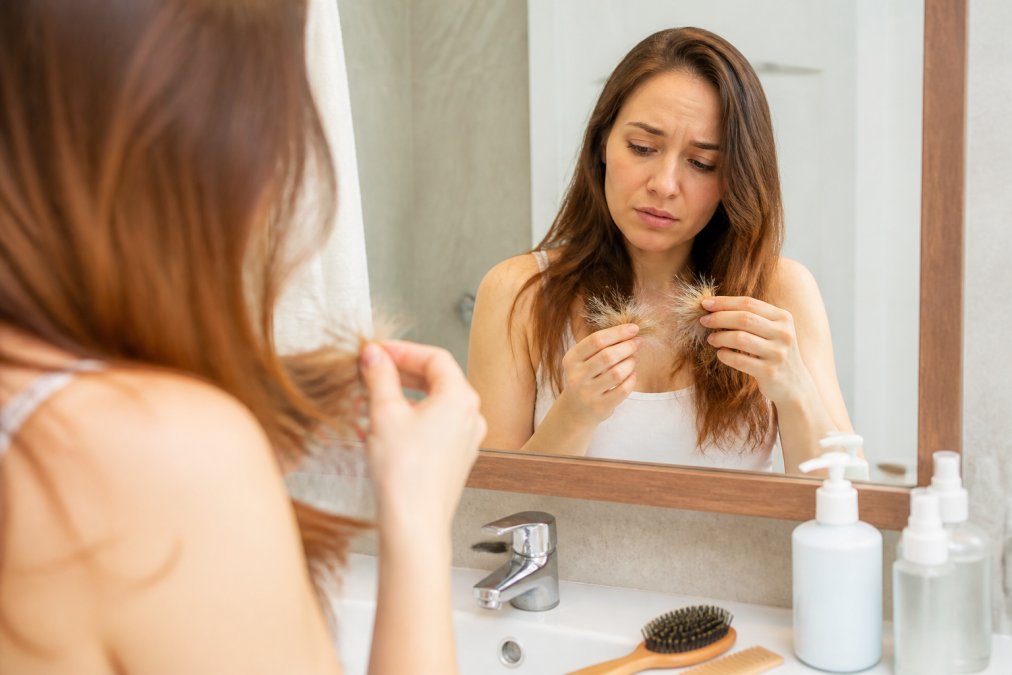
Straw-Like Texture and Brittle Hair
Brittle hair from protein overload feels rough even when soaking wet. Healthy hair stretches and glides under water; overloaded hair catches and drags. The fix is removal, not addition, layering more conditioner only coats the shaft without addressing the rigidity underneath.

Limp Strands, Tangled Hair, and Breakage
Limp strands at the roots paired with tangled hair mid-shaft point to a protein-moisture imbalance. The cuticle has lost flexibility, so strands catch on each other. When the hair shaft can't bend, it fractures. Short and mid-length breakage (rather than full-length strands with root bulbs) separates breakage from normal shedding.
Moisture Overload Symptoms vs Protein Overload
Moisture-overloaded hair feels mushy, stretchy, and gummy when wet, stretching too far before snapping back or not at all. Protein-overloaded hair does the reverse: it feels stiff, resists stretching, and breaks cleanly with little give. This opposite pattern is why misdiagnosis is common.
| Signal | Protein Overload | Moisture Overload |
|---|---|---|
| Wet feel | Stiff, straw-like | Mushy, gummy |
| Stretch test | Snaps with no stretch | Stretches too far |
| Shine | Dull, flat | Frizzy, undefined |
| Breakage pattern | Clean snaps mid-shaft | Limp, weak ends |
| Fix | Moisture + clarify | Protein + less conditioner |
The two can coexist. Over-processed hair often shows protein overload at the ends and moisture overload near the scalp, which is why a single-product fix rarely works.
The Hair Porosity Test: Why It Changes Your Fix
Porosity describes how open your hair's outer cuticle layer is and decides how fast protein and moisture move in and out of the shaft. Protein overload does not look the same on every head because the porosity of your cuticle is the single biggest variable in how quickly protein stacks up and how hard it is to remove.
The cuticle is a set of overlapping scales. When those scales lie flat and tight, the shaft is low porosity: water and product sit on the surface and penetrate slowly. When the scales are lifted or worn, the shaft is high porosity: it drinks in product fast and loses moisture just as fast. Protein molecules behave differently in each case.
- Low-porosity hair resists penetration, so hydrolyzed protein and keratin coat the outside of the cuticle instead of absorbing. Buildup happens fast and is stubborn because the product never penetrated deep enough to be shed normally.
- High-porosity hair absorbs protein quickly, which can temporarily patch gaps in a damaged cuticle but also loses the moisture protein needs to stay flexible. It swings from 'helped' to 'overloaded' within a few applications because it takes in so much at once.
- Medium-porosity hair is the most forgiving and tolerates the widest spacing between protein treatments.
Run the Float Test, Then Read the Result Correctly
The float test is a starting point, not a diagnosis. Use a clean strand with no product on it:
- Drop a single shed strand into a glass of room-temperature water
- Watch it for 2-4 minutes without stirring
- Floats on top the whole time: low porosity
- Sinks slowly and hovers mid-glass: medium porosity
- Sinks straight to the bottom: high porosity
Two caveats: a strand coated in silicone, oil, or leave-in will float regardless of true porosity, so clarify before testing. Porosity also varies along a single strand, ends are often more porous than roots. If your roots float and ends sink, you have mixed porosity, and protein overload will show up first at the ends.
How Porosity Changes Your Protein Recovery
Once you know your porosity, the recovery plan adjusts:
- Low porosity: lean hardest into clarifying and moisture. A chelating or clarifying wash removes surface protein. Space future protein treatments every 6-8 weeks at most, using lightweight, low-molecular-weight proteins only when elasticity is clearly good.
- High porosity: clarify gently since the cuticle is already compromised. Layer moisture and seal it with oils or butters after any protein use. Reintroduce protein sooner but in smaller amounts, always followed by a moisture seal.
- Medium porosity: the standard four-to-eight-week recovery and every-4-6-week protein cadence applies.
If unsure of your porosity, default to treating your hair as low porosity for the first two weeks. Clarifying and moisturizing are safe for every porosity level; adding protein carries risk, so delay it until you have a clearer read.
How to Fix Protein Overload Without Losing Progress
Fixing protein overload starts with removing excess buildup, then rebuilding moisture balance over several weeks. There is no overnight reset.
Follow this recovery sequence:
- Clarify first. Use a clarifying shampoo to strip residue and product buildup. Kerarganic's Clarifying Shampoo Premium - Step 1 opens the cuticle and clears the hair shaft before treatment.
- Pause all protein. Stop hydrolyzed protein, keratin, and amino acid products for at least two to three weeks.
- Moisturize deeply. Swap in moisture-focused deep conditioning twice weekly. Look for humectants and oils, not protein.
- Cut back on heat. Skip flat irons and blow dryers during recovery. Heat compounds cuticle damage.
- Trim the damage. Split ends won't recover. A trim protects the healthy hair above them.
- Reintroduce protein slowly. After elasticity returns, add one protein product back every two weeks.
Recovery typically takes four to eight weeks depending on how much buildup you're carrying and how porous your hair is (the American Academy of Dermatology). Expect the first improvement in texture within two weeks if you follow the sequence consistently.
DIY vs. Professional Intervention
DIY recovery works for mild to moderate protein overload with some elasticity remaining and breakage limited to the ends. Professional intervention makes sense when hair snaps immediately when wet, multiple chemical services are stacked close together, or breakage is near the scalp. Kerarganic's formaldehyde-free formulations are designed to extend keratin treatment results without adding to protein stress.
Preventing Protein Overload: Ingredient Decoding and Routine
Prevention is a labeling skill. Most people overload their hair without buying a product called a 'protein treatment' because protein hides under dozens of names in products marketed as moisturizing, repairing, or strengthening. Learning to read the ingredient list and its order is the single most useful habit you can build.
Decode the Label: What Counts as Protein
On a U.S. ingredient list, ingredients are listed in descending order by concentration (the FDA). If a protein appears in the first five ingredients, the product is functionally a protein treatment no matter what the front label says (the FDA).
Common protein ingredients to scan for:
- Hydrolyzed proteins: hydrolyzed wheat protein, hydrolyzed silk, hydrolyzed rice protein, hydrolyzed soy protein, hydrolyzed oat protein, hydrolyzed corn protein, hydrolyzed collagen
- Named proteins: keratin, collagen, silk protein, wheat protein, soy protein, milk protein, egg protein
- Amino acids and protein-adjacent: amino acids, silk amino acids, wheat amino acids, hydrolyzed keratin, keratin amino acids
- Peptides: any ingredient ending in '-peptide' or labeled as a protein peptide
Common moisture ingredients that balance protein:
- Humectants: glycerin, aloe vera, hyaluronic acid, honey, panthenol (provitamin B5)
- Emollients and sealants: shea butter, cocoa butter, coconut oil, jojoba oil, argan oil, avocado oil
- Conditioning agents: fatty alcohols such as cetyl and cetearyl alcohol (these are moisturizing, not drying, despite the word 'alcohol')
Clarifying and chelating ingredients that remove buildup:
- Clarifying surfactants: sodium C14-16 olefin sulfonate, cocamidopropyl betaine in a clarifying base
- Chelating agents: EDTA, phytic acid, citric acid (in chelating formulas)
If you see two or more protein ingredients in the top ten, treat the product as a protein product and rotate it, do not use it daily.
Build a Spacing Framework, Not a Product Pile
Most overload results from frequency, not any single product. Protein treatments are meant to be occasional but get used weekly because labels say 'repair.' Space them deliberately:
- Weekly: one clarifying or chelating wash to clear surface buildup
- Twice weekly: a moisture-focused deep conditioning mask, applied to damp hair and left on per the label
- Every 4-6 weeks: one protein treatment, and only if a wet strand still stretches before it snaps
- Daily: a sulfate-free shampoo and a moisture-leaning conditioner to protect the cuticle between treatments
If you color, bleach, relax, or heat-style regularly, shorten the interval between clarifying washes and lengthen the interval between protein treatments. If your hair is virgin and low porosity, clarify less often and be stingy with protein.
Watch the Hidden Sources
Protein hides in leave-in conditioners, heat protectants, curl creams, edge controls, and volumizing sprays. If in recovery, audit every product you apply after washing. A leave-in with hydrolyzed silk used daily can quietly push you back into overload even while your wash-day routine looks balanced.
Kerarganic's Ultra Gold Detox Shampoo Premium - Step 1 is built for the weekly reset step, clearing residue so the hair shaft can absorb moisture again. For stylists and distributors, the Fiberplasty Micellar Prep Shampoo - Step 1 applies micellar technology to cleanse gently without stripping, which matters when you are working with already-compromised hair.
Conclusion
Protein overload is reversible if you stop adding protein before removing it. Diagnose the signs, run the porosity test, clarify, and rebuild moisture over four to eight weeks. Kerarganic Cosmetics, LLC provides professional-quality, keratin-infused hair care solutions designed to enhance the health and vibrancy of all hair types and textures. Our comprehensive range of products, including formaldehyde-free treatments and restorative serums, helps rebuild strength, eliminate frizz, and maintain salon-perfect results at home. Whether you are a professional stylist or seeking a DIY hair repair solution, our nourishing formulas deliver essential nutrients for stronger, shinier, and more manageable hair. Experience the transformative power of our premium, organic-based collections tailored to protect and revitalize your hair from root to tip.
Frequently Asked Questions
How do you fix protein overload in your hair?
Stop using protein-heavy products and switch to moisturizing ones. Use a clarifying shampoo like Kerarganic's Clarifying Shampoo Premium - Step 1 ($21.80) to remove buildup, then deep condition with a product free of hydrolyzed protein. Focus on moisture balance for 2-4 weeks. Avoid heat styling and harsh treatments until hair elasticity returns. If hair feels straw-like, a trim may be needed to remove split ends.
How long does it take to reverse protein overload in hair?
Recovery typically takes 2 to 6 weeks, depending on damage severity and hair porosity. During recovery, avoid all protein ingredients and use a chelating shampoo once weekly to remove buildup.
What is the best shampoo for protein overload in hair?
Look for a clarifying or chelating shampoo free of hydrolyzed protein, keratin, and amino acids. Kerarganic's Clarifying Shampoo Premium - Step 1 ($21.80) removes residues and opens the cuticle without adding protein. For a gentler option, try the Fiberplasty Micellar Prep Shampoo ($10.40), which uses micellar technology to cleanse without stripping. Avoid sulfate-heavy formulas if your scalp is sensitive.
Can protein overload cause hair breakage?
Yes. When hair has too much protein, it becomes stiff and loses elasticity. This makes strands snap easily, especially when wet or during detangling. Breakage often appears as short, uneven pieces along the hair shaft. You may also notice split ends and tangling. The fix is to restore moisture balance with deep conditioning and avoid further protein treatments until hair feels soft and stretchy again.