
Table of Contents
- Quick Hair Styling Tips for Fine Hair: Start With the Right Foundation
- How to Add Volume to Fine Hair Without Weighing It Down
- Best Products for Fine Hair Volume: Lightweight Styling Options
- Quick Hairstyles for Fine Hair That Actually Hold
- Managing Oily Roots and Avoiding Product Buildup
- Common Styling Mistakes to Avoid With Fine Hair
- Frequently Asked Questions
Last Updated: October 15, 2026
Quick Hair Styling Tips for Fine Hair: Start With the Right Foundation
Fine hair demands a different approach than thicker textures. The wrong products weigh it down. The wrong techniques flatten it. But quick hair styling tips for fine hair aren't complicated, they're just specific.
The turning point is a foundation of lightweight shampoo and conditioner that supports volume rather than crushing it.
Fine hair has less surface area per strand, so heavy products cling, buildup accumulates faster, and moisture sits on the scalp instead of distributing down the shaft. Fix these basics and styling gets easier.
Choose a Lightweight Shampoo and Conditioner
Your shampoo and conditioner set the tone for everything that follows, so for fine hair lightweight formulas are essential.
Look for shampoos fortified with volumizing agents like biotin and collagen. The American Academy of Dermatology recommends using products that strengthen hair without adding weight.
The VOLUME PLUS THICKENING FORTIFYING BIOTIN AND COLLAGEN SHAMPOO from Kerarganic includes biotin, garlic extract, chia seed oil, and aloe leaf juice, nourishing roots.

Conditioner strategy matters even more than shampoo choice. Most people apply it to their entire head, weighing down fine hair at the roots.
The VOLUME PLUS BIOTIN THICKENING FORTIFYING CONDITIONER from Kerarganic fortifies with biotin and natural ingredients, but you control where it goes.
Apply Conditioner Strategically to Avoid Oily Roots
Your scalp produces sebum, and fine hair can't distribute that oil down the shaft the way thick hair does. Adding conditioner to the roots doubles down on moisture where hair least needs it, leaving oily roots by midday.
The fix is mechanical: section hair into four quadrants, apply conditioner only to the lower two-thirds of each section starting two inches below the scalp, massage gently, leave it on while you finish your shower, then rinse. It takes 30 seconds longer but eliminates root flatness.
How to Add Volume to Fine Hair Without Weighing It Down
Volume is the primary styling goal for fine hair, which looks thin and limp without it no matter how healthy it is. Volume comes from technique and product choice, not expensive salon treatments.
Fine hair needs root lift more than anything else; it creates the illusion of fullness across the entire head.
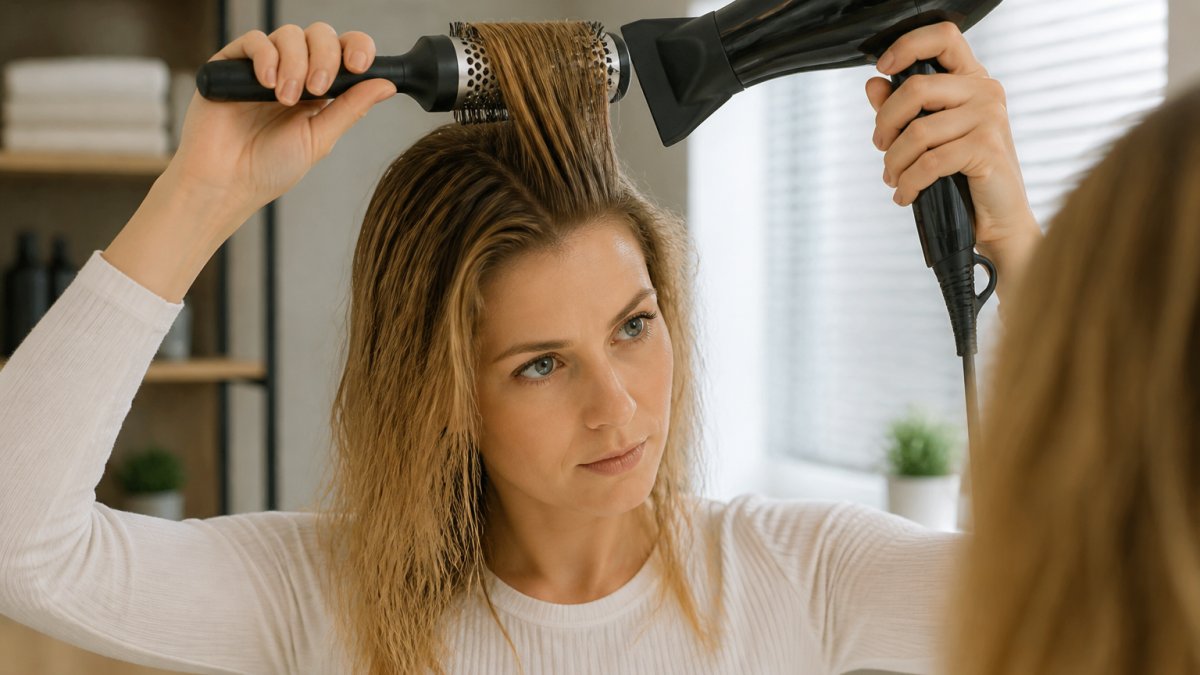
Blow-Drying Techniques for Root Lift and Fuller-Looking Hair
Blow-drying is the fastest way to add volume to fine hair.
Start with damp hair, not soaking wet, which takes too long to dry and stretches under its own weight, flattening the roots.
Use a concentrator nozzle to focus heat and airflow.
Here's the root-lift technique: section hair into four quadrants, start at the back, and lift a small subsection straight up with a round brush.
Work through all four sections, always lifting hair away from the scalp, and spend extra time on the visible front and sides.
Towel Drying and Detangling Methods
How you towel-dry matters more than most people realize: rough drying breaks fine hair and flattens roots before styling even starts.
Use a microfiber towel or old cotton t-shirt instead of a bath towel.
Gently squeeze water out, don't rub, holding each section 3-5 seconds from roots to ends. Flip your head upside down and squeeze the roots section by section to remove excess water without damage.
Detangle while hair is damp, before blow-drying, using a wide-tooth comb rather than a brush. Start at the ends and work upward slowly in small sections.
Best Products for Fine Hair Volume: Lightweight Styling Options
Product choice determines whether your styling efforts stick or fall flat by afternoon. Fine hair needs hold and texture without weight or buildup.
Heavy mousses, thick gels, and pomades sit on fine hair like a weight, clumping instead of distributing evenly and making hair look greasy rather than voluminous. Lightweight products are non-negotiable.
Mousse or Gel for Fine Hair: Which Works Better
Mousse and gel approach volume differently. Understanding the difference helps you choose the right tool for your hair pattern and styling goals.
Mousse is lighter and gives more natural-looking volume. The foam distributes evenly without clumping, adding texture and hold without weight.
Gel is heavier and provides stronger hold, better for fine hair that must stay in place all day or textured styles needing more control.
For most fine-haired people, mousse is the better daily choice, providing volume without gel's stiffness or weight. For stronger hold on specific occasions, gel works, but use less than you think you need.
Finishing Sprays and Lightweight Oils for Hold and Shine
Finishing products lock in your styling work and add shine without heavy oils.
Spray it on dry hair after styling, focusing on mid-lengths and ends and avoiding roots and scalp. It seals the cuticle, extending your style's longevity and adding shine.
For heat protection during blow-drying, the ARGAN REVITALIZING OIL from Kerarganic works as a thermal protector. Apply a few drops to damp hair before blow-drying, distributing evenly with your fingers.
Quick Hairstyles for Fine Hair That Actually Hold
Fine hair holds styles differently than thick hair. Volume-based styles work better than length-dependent ones. Texture matters more than shape.
VOLUME PLUS THICKENING FORTIFYING BIOTIN AND COLLAGEN SHAMPOO →
Quick hairstyles for fine hair succeed when they rely on root lift and texture rather than weight or length. A sleek, straight style shows every flaw, while a textured style hides thinness and creates the illusion of fullness.
Textured Waves and Layers for Instant Fullness
Textured waves are the fastest way to add visual fullness to fine hair, creating dimension that makes hair look thicker.
The technique takes 10-15 minutes.
Curl from about the midpoint downward rather than the entire length, keeping roots light and preventing the weighted-down look of curling from the scalp.
Finish with a light hairspray to set the waves. The FIBERPLASTY 7-OIL FINISHING SPRAY works as a finishing product, but for waves that need to hold, a traditional hairspray provides stronger hold without adding weight.
Layers are equally important, creating movement and the illusion of fullness.
Styling Routines for Different Hair Patterns and Conditions
Fine hair comes in different patterns, straight, wavy, curly. The styling approach changes based on your pattern.
Straight fine hair benefits most from root lift and texture.
Wavy fine hair has natural texture to work with, so enhance the waves rather than fighting them.
Curly fine hair needs moisture and definition without weight. Use a lightweight conditioner on mid-lengths and ends only, apply a curl-defining cream to damp hair, and air-dry or diffuse on low heat.
For all patterns the routine is the same: lightweight shampoo and conditioner, strategic product application, proper blow-drying or air-drying, and finishing spray.
Managing Oily Roots and Avoiding Product Buildup
Oily roots plague fine hair: the scalp produces oil, fine hair can't distribute it, and styling products build up, leaving roots flat and greasy by midday.
Prevention is easier than treatment: use lightweight products, apply conditioner only to ends, and clarify regularly. When oily roots happen anyway, you need a quick fix.
Clarifying Shampoo Schedule and Scalp Massage Techniques
Clarifying shampoo removes buildup regular shampoo leaves behind. Use it once every two weeks, or weekly if you use a lot of styling products.
Clarifying shampoo is stronger than regular shampoo, stripping away buildup, oils, and product residue.
When you clarify, massage your scalp with fingertips, not nails, using gentle circular pressure from front to back for 2-3 minutes. This loosens buildup and improves blood flow, supporting healthier growth.
After clarifying, follow with the VOLUME PLUS BIOTIN THICKENING FORTIFYING CONDITIONER, applied only to mid-lengths and ends, to counter the drying effect without weighing down roots.

Heat Protection and Low-Heat Styling Alternatives
Heat styling damages fine hair faster than thick hair because less mass means less protection. Damaged fine hair looks thinner and breaks more easily.
Use heat protectant every time you blow-dry or use a hot tool.
Low-heat alternatives preserve fine hair and often look better. Air-drying with mousse creates softer waves than a curling iron, and braiding damp hair and letting it air-dry adds texture with no heat damage.
When you do use heat, use lower temperatures. Fine hair needs less heat than thick hair: a blow dryer on medium and a curling iron at 300°F work for most fine hair.
Common Styling Mistakes to Avoid With Fine Hair
Fine hair reveals mistakes faster than thick hair. Mistakes compound visibly. Understanding what doesn't work prevents wasted time and frustration.
Mistake 2: Applying conditioner to the scalp. This is the single biggest reason fine hair looks flat.
Mistake 3: Rough towel drying. Fine hair breaks under friction.
Mistake 4: Skipping heat protectant. Heat damage accumulates.
Mistake 5: Waiting too long between clarifying. Buildup accumulates faster on fine hair, so clarify every two weeks, or weekly if you use a lot of products.
Mistake 6: Blow-drying only the ends. Root lift creates volume on fine hair.
Fine hair requires a different approach than thicker textures, but it's straightforward: start with lightweight shampoo and conditioner, blow-dry for root lift, use texture-based styles, and avoid heavy products. The VOLUME PLUS BIOTIN SHAMPOO AND CONDITIONER COLLECTION BUNDLE from Kerarganic ($41.80) gives you the foundation, with both products working together to support volume without weight.

Frequently Asked Questions
What are the best products for fine hair volume without weighing it down?
Lightweight volumizing shampoos and conditioners are essential. The Volume Plus Biotin Thickening Shampoo and Conditioner ($24.60 each) fortify hair with biotin and natural ingredients while nourishing roots. Avoid heavy oils on the scalp; instead, use lightweight finishing sprays like Fiberplasty 7-Oil Finishing Spray ($19.20) on ends only. Volumizing products should always be applied to roots and mid-lengths, never the scalp itself.
Should I use mousse or gel for fine hair?
Mousse is generally better for fine hair because it provides hold and texture with minimal weight. Gel tends to be heavier and can flatten fine hair, especially at the roots. Mousse creates lift when applied to damp roots before blow-drying, giving you fuller-looking hair without the stiffness or residue that gel can leave behind. For styling fine hair, mousse offers the best balance of hold and weightlessness.
How often should I shampoo fine hair to prevent oily roots?
Most people with fine hair benefit from shampooing every 2-3 days. Fine hair tends to show oil faster because there's less volume to absorb scalp oils. Use a lightweight volumizing shampoo like Volume Plus Biotin Shampoo to cleanse without stripping. Between washes, dry shampoo can absorb excess oil at the roots. If your hair feels greasy daily, clarifying shampoo once weekly removes product buildup that can make fine hair look limp and weighted down.
Can I use heat styling on fine hair without damaging it?
Yes, with proper protection. Always apply a heat protectant before blow-drying or using hot tools. Argan Revitalizing Oil ($18.90) works as an effective thermal protector and can be applied to damp hair before blow-drying. Use lower heat settings when possible, and focus heat at the roots for volume rather than on delicate ends. Air-drying with mousse is a low-heat alternative that still delivers texture and hold for fine hair.