
Table of Contents
- Best Shampoos for Keratin Treated Hair: Quick Comparison
- 1. Keratin Shampoo Maintenance: Budget-Friendly Daily Cleansing
- 2. Premium Keratin Shampoo for Straight Hair: Specialized Maintenance
- 3. Fiberplasty Micellar Rejuvenating Shampoo: Scalp Detox & Repair
- 4. Xtreme Repair Restorative Shampoo: Heavy-Duty Damage Recovery
- 5. Premium Home Care Bundle: Complete Aftercare System
- Sulfate-Free Shampoo for Keratin-Treated Hair: What Matters Most
- Best Shampoo and Conditioner After Keratin Treatment: Pairing Strategy
- Frequently Asked Questions
Last Updated: October 12, 2026
Best Shampoos for Keratin Treated Hair: Quick Comparison
The wrong shampoo can diminish a keratin treatment; the right one can help extend smoothness and shine.
The best shampoo for keratin treated hair is sulfate-free, keratin-enriched, and paired with a matching conditioner that locks in moisture without buildup.
Sulfates can strip the protective keratin layer, and many shampoos contain them. Premium formulas often use gentle surfactants that cleanse without removing the nutrients treated hair needs.
How We Evaluated These Products
| Product | Price | Key Benefit | Best For |
|---|---|---|---|
| Keratin Shampoo Maintenance | $14.60 | Budget-friendly daily cleansing | All hair types post-treatment |
| Premium Keratin Shampoo for Straight Hair | $15.80 | Specialized straight hair maintenance | Freshly straightened hair |
| Fiberplasty Micellar Rejuvenating Shampoo | $16.10 | Scalp detox and repair | Buildup removal and scalp health |
| Xtreme Repair Restorative Shampoo | $24.00 | Heavy-duty damage recovery | Severely compromised hair |
| Premium Home Care Bundle | $78.80 | Complete aftercare system | Long-term treatment maintenance |
1. Keratin Shampoo Maintenance: Budget-Friendly Daily Cleansing
The Keratin Shampoo Maintenance delivers what most people need from a post-treatment shampoo without the premium price tag. At $14.60, it's the entry point for preserving a keratin treatment without overspending.


It combines hydrolyzed keratin with argan oil and silk amino acids to repair damaged fibers while you cleanse. Aloe vera soothes the scalp, panthenol boosts moisture retention, and a UV filter guards against sun damage that accelerates fading.
What works: The price-to-performance ratio is hard to beat.
2. Premium Keratin Shampoo for Straight Hair: Specialized Maintenance
If your keratin treatment was designed to straighten your hair, this premium formula ($15.80) targets that exact need rather than general keratin maintenance.
It includes hydrolyzed keratin plus Brazilian keratin treatment elements alongside argan kernel oil and silk amino acids, rebuilding elasticity while preventing the frizz that creeps back as the treatment ages.
The real difference: straightened hair has different needs than treated curly or wavy hair. This shampoo conditions more aggressively while cleansing gently.
Pair it with the Premium Keratin Conditioner Post-Straightening ($15.80).
3. Fiberplasty Micellar Rejuvenating Shampoo: Scalp Detox & Repair
This one ($16.10) solves a problem most keratin shampoos ignore: scalp buildup. Micellar technology removes only unwanted residue while preserving your hair's natural nutrients.
It detoxes and refreshes the scalp while stimulating circulation. Hyaluronic acid, soy protein, and wheat germ oil condition as you cleanse, while apple, beet, and camellia extracts add antioxidant protection. The scent is cherry blossom with citrus.
What makes this different: after weeks of keratin treatments and leave-in conditioners, your scalp accumulates residue. This shampoo clears it without stripping, and it's color-safe.
4. Xtreme Repair Restorative Shampoo: Heavy-Duty Damage Recovery
At $24.00, this is the heavy hitter for keratin-treated hair that's taken a beating: stacked treatments, heat damage, color processing on top of straightening, or months of neglect.
The concentrated formula packs hydrolyzed keratin, argan oil, and silk amino acids at higher concentrations than standard maintenance shampoos. Aloe vera and panthenol provide deep hydration, a color anti-fading complex protects dyed hair, and UV and heat protection shield against future damage.
This shampoo doesn't just maintain; it rebuilds. The thick, creamy formula coats damaged fibers and reinforces their structure.
The tradeoff: it's richer than daily shampoos. Use it 1-2 times per week, alternating with a lighter maintenance formula.
5. Premium Home Care Bundle: Complete Aftercare System
The Premium Home Care Bundle ($78.80) covers long-term keratin maintenance: shampoo, conditioner, intensive mask, leave-in conditioner spray, and argan revitalizing oil.
The shampoo gently cleanses, the conditioner prolongs treatment effects, the weekly mask nourishes, the leave-in spray adds heat protection and detangling, and the argan oil seals it all in.
What makes bundles valuable: consistency. Complementary products from the same line work synergistically.
Best for: anyone serious about maximizing treatment longevity, the bundle ensures the right product for every step of your routine.
Sulfate-Free Shampoo for Keratin-Treated Hair: What Matters Most
"Sulfate-free" is the label every keratin shampoo markets, but it tells you almost nothing. Two sulfate-free shampoos can behave completely differently on treated hair depending on which surfactants replace the sulfates and whether the formula contains salt-related ingredients that quietly undo smoothing treatments.
The surfactant system: what replaced the sulfates
Surfactants lift oil and dirt off hair so water can rinse them away. The harsh ones, sodium lauryl sulfate (SLS) and sodium laureth sulfate (SLES), are anionic, carrying a negative charge that binds aggressively to the hair's surface and to the keratin layer a smoothing treatment deposits, which is why they strip treatments fast.
Gentle replacements fall into three families:
- Glucosides (decyl glucoside, coco-glucoside): Nonionic, very mild, low-lather. Excellent for color-treated and fine hair because they cleanse without swelling the cuticle much. Trade-off: they can leave a slight film on very oily scalps.
- Betaines (cocamidopropyl betaine): Amphoteric, meaning they carry both charges and behave gently across a wide pH range. This is the workhorse in most quality sulfate-free formulas. It lathers better than glucosides and rinses clean.
- Isethionates (sodium cocoyl isethionate, sodium lauroyl methyl isethionate): Anionic but large-molecule, so they cleanse effectively while being far less stripping than SLS. Common in salon-tier formulas.
A lone glucoside may not remove heavy silicone buildup.
The salt question: sodium chloride and 'salt-free' claims
Many keratin and Brazilian blowout aftercare guides warn against sodium chloride (table salt), a cheap thickener in some shampoos. Salt can draw moisture out of hair and, in some smoothing systems, disrupt the bond the treatment formed. A salt-free or low-salt formula removes one variable you don't need to gamble on.
Check the ingredient list for "sodium chloride" and "magnesium sulfate." Neither is dangerous, but both are avoidable in a dedicated aftercare shampoo.
Match the formula to your treatment type
Not all smoothing treatments are the same, and aftercare differs:
- Formaldehyde-releasing / Brazilian-style treatments: These rely on a protein-and-polymer coating. Most practitioners advise waiting 72 hours before the first wash so the coating fully sets, then using sulfate-free, salt-free shampoo thereafter.
- Cysteine and other amino-acid smoothing systems: These break and reform bonds inside the hair rather than coating it. They tolerate a slightly stronger surfactant, but still benefit from sulfate-free cleansing to protect color and moisture balance.
- Keratin protein treatments (no straightening): These deposit hydrolyzed protein into the cuticle. They're the most forgiving, but benefit most from shampoos that also contain hydrolyzed keratin so the protein isn't washed out over time.
If you're unsure which category your salon used, ask, it changes how strict you must be about the first wash and salt content.
The ingredients that actually extend results
Beyond surfactants, three ingredient categories do measurable work:
- Hydrolyzed keratin and hydrolyzed silk: Proteins broken into fragments small enough to penetrate the cuticle and temporarily fill gaps. Look for them near the top of the list, not buried after fragrance.
- Humectants (panthenol, glycerin, hyaluronic acid): They pull water into the hair shaft, keeping treated hair from feeling stiff and brittle as the treatment ages.
- UV filters (often benzophenone-4 or a plant-derived alternative): Sun exposure is one of the most underrated causes of treatment fade. A UV filter buys weeks.
What to skip
Alongside SLS and SLES, watch for drying alcohols (denatured alcohol, SD alcohol) near the top of the list, and heavy non-soluble silicones if you're prone to buildup.
FDA information on cosmetic ingredient labeling
Best Shampoo and Conditioner After Keratin Treatment: Pairing Strategy
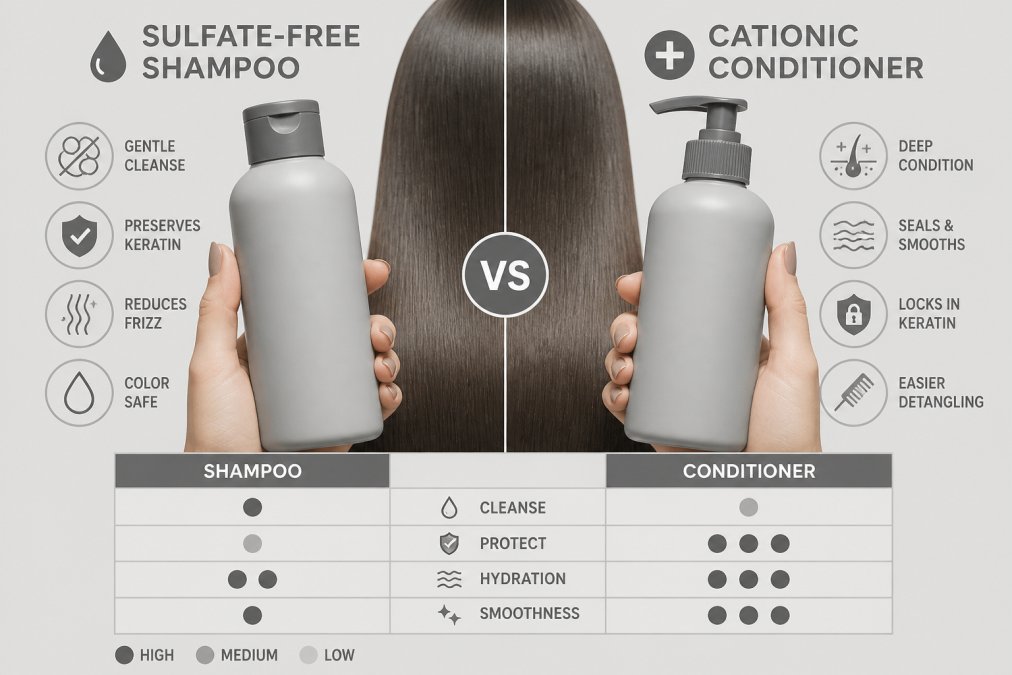
Shampoo and conditioner do opposite jobs, which is why pairing them well matters more on treated hair.
Why the pairing matters more than either bottle alone
Shampoo is anionic and slightly alkaline, lifting the cuticle to rinse away oil and residue. Conditioner is cationic and acidic, laying the cuticle flat, neutralizing the negative charge, and sealing the surface. On untreated hair a mismatched pair is a minor annoyance; on keratin-treated hair it can impact the smoothness and longevity of the treatment.
After shampooing, hair's surface is negatively charged and the cuticle slightly raised. A cationic conditioner binds to that charge and smooths the cuticle down. If your conditioner is weak or the wrong pH, the cuticle stays raised, and frizz and dullness can result.
How to read a pairing like a formulator
You don't need a chemistry degree, just check three things:
- pH. Treated hair prefers an acidic conditioner (roughly pH 3.5-5), where most quality post-treatment conditioners sit.
- Cationic ingredients. Look for behentrimonium methosulfate, cetrimonium chloride, or behentrimonium chloride, the agents that bind to and smooth the cuticle. A conditioner relying only on oils and silicones feels nice but won't seal the cuticle.
- Protein balance. Hydrolyzed keratin reinforces the treatment, but protein-heavy conditioners used every wash can cause protein overload and stiff hair. If hair feels straw-like, rotate to a moisture-focused conditioner for a week.
Pairing by treatment goal
- Maintaining straightness: Pair a gentle sulfate-free shampoo with a conditioner containing cationic agents and light protein. Leave it on 3-5 minutes for a flat cuticle and smooth surface, not heavy coating.
- Preserving color on top of a treatment: Choose a conditioner with UV filters and no drying alcohols. Color and smoothing treatments fade on overlapping timelines, so one product protecting both saves layering two conditioners.
- Managing scalp buildup: Leave-ins, heat protectants, and dry shampoo leave residue a conditioning-heavy routine won't remove. Rotate in a clarifying or micellar shampoo every 2-3 weeks, then follow with a richer conditioner, skipping this is a common reason treated hair looks dull around the six-week mark.
- Fine or thin treated hair: Heavy conditioners weigh fine hair down and look greasy at the roots. Use a lightweight cationic conditioner on mid-lengths and ends only.
- Thick, coarse, or coily treated hair: Use a richer conditioner and leave it on longer. Coily hair often needs a leave-in layered over the rinse-out conditioner to hold moisture between washes.
The mistake that undoes a good shampoo
Using a premium sulfate-free shampoo followed by a cheap, high-pH conditioner can impact results. The shampoo does its job, then the conditioner raises the cuticle and leaves the surface rough. If you invest in one half of the pair, invest in the conditioner.
A simple test to know if your pairing is working
After your next wash and condition, air-dry without styling product and run your fingers from mid-length to ends. Smooth and slightly cool means the cuticle is sealed and your pairing works. Rough, grabby, or dry ends mean your conditioner isn't sealing the cuticle.
Frequently Asked Questions
What kind of shampoo should you use after a keratin treatment?
Use a sulfate-free shampoo specifically formulated for keratin-treated hair. Sulfates strip the protective keratin coating, cutting treatment longevity in half. Look for shampoos with hydrolyzed keratin, argan oil, and UV filters. The Keratin Shampoo Maintenance ($14.60) or Premium Keratin Shampoo for Straight Hair ($15.80) are designed to cleanse gently while preserving your treatment's smoothing benefits.
Should you use sulfate-free shampoo after a keratin treatment?
Yes, sulfate-free is non-negotiable. Sulfates are harsh detergents that can compromise the keratin protein in your hair. After a keratin treatment, your hair's cuticle is sealed with this protein layer, sulfates can diminish its integrity. All Kerarganic keratin shampoos are sulfate-free and formulated to preserve treatment results while cleansing buildup.
How often should you wash keratin-treated hair?
Limit washing to 2-3 times weekly to extend treatment life. Use lukewarm water, not hot. Pair with a conditioning treatment once weekly to replenish moisture and strengthen fibers.
How do you make a keratin treatment last longer?
Extend treatment longevity by washing less frequently, using sulfate-free shampoo and conditioner, applying a leave-in conditioner or oil between washes, minimizing heat styling, and using UV protection products. The Premium Home Care Bundle ($78.80) includes all essentials: shampoo, conditioner, mask, leave-in spray, and argan oil.