
Last Updated: October 25, 2026
Quick Summary
A professional hair care inventory starts by assessing your salon's service menu and weekly client volume, then selecting professional-grade products organized into back-bar service products, retail display items, and consumable supplies. Use a starter inventory table as your baseline, adjust quantities to match your actual service volume, and track stock weekly with a spreadsheet to prevent stockouts and overstock.
- Calculate your reorder point using the formula: (Average Daily Usage × Lead Time in Days) + Safety Stock to balance having enough product without overstock.
- Implement first-in-first-out rotation by placing new stock behind existing inventory and checking expiration dates monthly to prevent waste and quality degradation.
- Organize your backbar by category with clear labels showing product names, sizes, and expiration dates so any staff member can find items in seconds.
- Update your inventory tracking spreadsheet weekly, recording what sold and what remains, to identify usage patterns and forecast demand accurately.
Table of Contents
- Assess Your Salon's Service Menu and Client Volume
- Select Your Professional Hair Care Products
- Create a Salon Hair Product Inventory Checklist
- Organize and Store Your Salon Backbar Inventory
- Set Up a Salon Inventory Tracking Spreadsheet
- Establish Your Salon Product Reorder Point
- Implement Stock Rotation and Expiry Management
- Launch Your Inventory System
- Frequently Asked Questions
Assess Your Salon's Service Menu and Client Volume
Building a professional hair care inventory starts with understanding what your salon actually does.
Ask yourself these questions:
- What services do you offer (cuts, color, treatments, styling)?
- How many clients book each service per week?
- Which services generate the most revenue?
Your answers determine inventory depth: a keratin salon needs different stock than a cut-and-style salon, and 40 weekly clients require more product than 15.
Track which services run most frequently; this data becomes your foundation for selecting products and setting reorder points.
Consider salon size too: a single-chair studio benefits from curated collections, while a 10-chair salon can justify broader ranges.
Select Your Professional Hair Care Products
Choose professional-grade products that align with your treatments, then build a categorized starter inventory in three tiers: back-bar service products, retail display products, and consumable supplies.
Start by identifying your core categories and the role each plays:
- Shampoos and conditioners for back-bar client use and retail
- Treatment masks and serums for in-salon services
- Styling products that complement your service offerings
A Practical Starter Inventory for Professional Hair Care
Use the table below as a planning baseline, not a rigid order form. Quantities assume a small salon with two to four chairs and roughly 30 to 50 client visits per week.
| Category | Example item type | Back-bar starting quantity | Retail starting quantity | Primary use case |
|---|---|---|---|---|
| Clarifying shampoo | Chelating or deep-clean shampoo | 1 liter | 2-3 bottles (8-10 oz) | Remove buildup before treatments and color |
| Daily shampoo | Sulfate-free or color-safe shampoo | 2 liters | 4-6 bottles | Standard wash and retail replenishment |
| Conditioner | Rinse-out conditioner | 2 liters | 4-6 bottles | Post-wash detangling and retail |
| Treatment mask | Hydrating or repair mask | 1-2 tubs (16-34 oz) | 2-3 tubs | Weekly deep-conditioning add-on service |
| Leave-in serum | Repair or smoothing serum | 2-3 bottles (3-4 oz) | 3-4 bottles | Blow-dry prep and retail |
| Styling product | Heat protectant, mousse, pomade | 2-3 units per type | 3-4 units per type | Finishing services and retail |
| Color care | Color-protecting shampoo and conditioner | 1 liter each | 3-4 bottles each | Color-treated client maintenance |
| Keratin or smoothing treatment | Formaldehyde-free smoothing system | 1 kit | Not typically retailed | Specialty smoothing services |
| Consumables | Applicator bottles, bowls, foils, gloves | 1-2 cases or packs | Not retailed | Daily service delivery |
Treat these numbers as a starting point and adjust after 30 days of tracking. A common pattern is overbuying retail styling products and underbuying back-bar shampoo, which is consumed invisibly during services.
Match Products to Your Service Mix
Quality matters more than quantity: three excellent products that sell consistently beat ten mediocre ones gathering dust. Select products your stylists believe in and will recommend.
When evaluating options, consider product performance, ingredient quality, and retail potential. Professional hair care collections like the Kerarganic professional product lines offer formaldehyde-free keratin treatments and restorative formulas designed for salon use and retail sales.
Look for products that solve real client problems: prioritize anti-frizz and repair collections if your clientele struggles with frizz and damage, or color-protection systems if color-treated hair dominates your base.
Build relationships with product representatives; they can guide you on which items perform best in salons like yours and help you understand margin structures.
Create a Salon Hair Product Inventory Checklist
A structured checklist ensures you capture every product type and quantity needed, becoming your reference guide for ordering and auditing.
Your checklist should include:
- Product name and brand
- Product category (shampoo, conditioner, treatment, etc.)
- Unit size (8 oz, 16 oz, liter, etc.)
This salon hair product inventory checklist is a living document you update weekly.
Include every product you stock, from back-bar professional items to retail bottles, plus styling tools, applicator bottles, and mixing bowls.
Review your checklist monthly. Mark items that moved quickly and those that sat untouched.
Organize and Store Your Salon Backbar Inventory
Organization directly impacts efficiency and product quality. A chaotic backbar wastes time, creates confusion, and damages products.
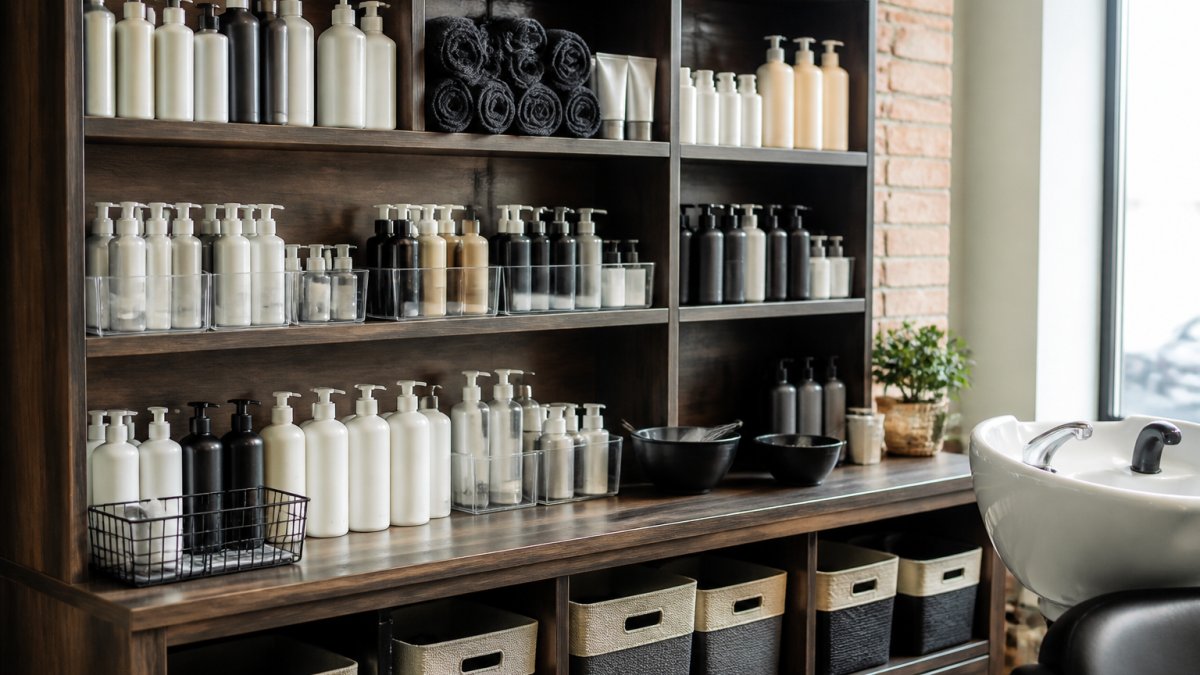
Group products by category:
- Hair treatments and masks in one area
- Shampoos and conditioners together
- Styling and finishing products grouped separately
Label shelves clearly with product names, sizes, and expiration dates; color-coded labels speed up identification during busy service times.
Implement a "first in, first out" rotation: place new stock behind existing inventory so older products sell first, preventing expiration waste.
Keep your backbar organized enough that any staff member can find what they need in seconds.
Set Up a Salon Inventory Tracking Spreadsheet
A salon inventory tracking spreadsheet gives you visibility into stock levels and usage patterns, preventing stockouts and identifying slow movers.
Set up columns for:
- Product name
- Current quantity on hand
- Quantity sold this week
Update your spreadsheet weekly, recording what sold and what remains. Patterns emerge: which products move daily and which sit for weeks.
Use your spreadsheet to forecast demand.
Spreadsheets work initially; as inventory grows, dedicated software offers automation and better reporting. Choose tools that integrate with your point-of-sale system.
ANGEL TOUCH COLOR CARE GUARDIAN COLLECTION BUNDLE →
Establish Your Salon Product Reorder Point
Your reorder point is the stock level that triggers a new order. Calculate it to balance having enough product with avoiding overstock. This method uses lead time, average usage, and a safety buffer, and works for back-bar consumption and retail sales.
Use this formula:
Reorder Point = (Average Daily Usage × Lead Time in Days) + Safety Stock
Here is how each input works:
- Average daily usage: Units consumed or sold per day. Divide weekly usage by 7.
- Lead time: Days from placing an order to receiving it, including any receiving and stocking delay.
- Safety stock: Extra units to cover demand spikes, delayed shipments, or a busy week.
Worked Example
Suppose your salon uses 10 units of back-bar shampoo per week and your supplier takes 14 days to deliver.
- Average daily usage = 10 ÷ 7 ≈ 1.43 units per day.
- Usage during lead time = 1.43 × 14 ≈ 20 units.
- Add safety stock. A common buffer is one to two weeks of usage. Two weeks is 20 units, so safety stock = 20 units.
- Reorder point = 20 + 20 = 40 units.
When back-bar shampoo drops to 40 units, place the next order. That level covers normal usage during the 14-day lead time plus a two-week cushion for busy periods or late deliveries.
Set Safety Stock by Product Type
Different products need different buffers. High-velocity back-bar items and color products should carry more safety stock because a stockout interrupts service. Slow-moving specialty treatments can carry less because overstock ties up cash and risks expiration.
| Product type | Typical safety-stock buffer | Reason |
|---|---|---|
| Back-bar shampoo and conditioner | 1-2 weeks of usage | Consumed daily; stockout blocks services |
| Color products | 1-2 weeks of usage | Service-critical and shade-specific |
| Treatment masks and serums | 1 week of usage | Used less frequently but hard to substitute |
| Retail styling products | 2-4 weeks of sales | Sold to clients; stockout loses retail revenue |
| Specialty smoothing kits | 1 kit beyond current demand | Expensive and slower-moving |
Adjust Reorder Points for Real-World Conditions
Review reorder points quarterly; as client volume grows, usage rates change, so update calculations to reflect current demand.
Different products need different reorder points: high-velocity shampoo might reorder at 40 units while slower specialty treatments reorder at 10.
Implement Stock Rotation and Expiry Management
Professional products have shelf lives (the FDA). Proper rotation ensures quality and prevents waste.
Implement a clear expiration date tracking system:
- Mark all products with arrival dates when stock arrives
- Check expiration dates monthly during audits
- Remove expired products immediately, never sell expired items
Use the first-in-first-out method consistently. New stock goes to the back. Staff pulls from the front.
Create a disposal plan for expired products.
Track which products expire fastest.
For color products and keratin treatments, expiration matters even more: expired color delivers poor results and expired keratin loses potency.
Launch Your Inventory System
Implementation happens in phases. Don't try to perfect everything immediately.
Week 1: Audit and Document
- Count everything currently in stock
- Document product names, sizes, and quantities
- Identify expired or damaged items
Week 2: Organize and Label
- Reorganize your backbar by category
- Add clear labels with product names and dates
- Create a visual system staff understands instantly
Week 3: Set Up Tracking
- Create your spreadsheet or choose software
- Input all current products and quantities
- Calculate reorder points for each item
Week 4: Train Your Team
- Show staff how to check inventory
- Explain the reorder point system
- Review proper product storage
Start simple.
Schedule weekly inventory checks. Fifteen minutes each week beats scrambling during crises.
Review your system monthly. What's working? What feels clunky? Adjust as you learn.
The payoff comes quickly: fewer stockouts and less waste.
Building a professional hair care inventory takes effort upfront but pays dividends through smoother operations and better business performance.
Effective inventory management transforms salon operations. Start with a clear assessment of your needs, select professional-grade products that match your services, and implement a tracking system you can maintain weekly. Kerarganic Cosmetics, LLC professional collections offer formaldehyde-free keratin treatments and restorative serums designed specifically for salon professionals.
Frequently Asked Questions
How do I decide which hair care products to stock in a salon?
Start by identifying your service menu and client demographics. If you offer keratin treatments, stock professional keratin-infused products like the XTREME REPAIR collection or KAKAWA bundle to support those services. Consider your client volume and average service frequency. For a small salon, begin with a core collection covering damage repair, color care, and volume enhancement. Survey your clients about their hair concerns and purchase products that address those needs. Kerarganic offers bundled collections that provide complete product lines at strategic price points, making it easier to build a cohesive professional inventory.
What is the correct order to put hair products in?
Apply products in this sequence: shampoo first to cleanse, then conditioner to hydrate and seal the cuticle, followed by treatment masks or serums for intensive repair, and finally leave-in conditioners or protective serums as finishing products. For salon services, apply treatments after shampooing and before conditioning. This order ensures each product layer penetrates effectively without being blocked by subsequent applications. When stocking your salon backbar inventory, organize products by this application sequence so stylists can quickly locate items in the correct order during client services.
How much hair care inventory should a salon keep on hand?
Calculate inventory based on your weekly product usage and lead time from suppliers. Most salons maintain a 2-4 week supply of fast-moving products (those used in daily services) and a 4-8 week supply of retail products sold to clients. For a small salon with 3-5 stylists, start with one full set of your core professional hair care inventory plus backup stock of best-sellers. Use your salon inventory tracking spreadsheet to monitor usage rates. Kerarganic's bundled collections ($41.80-$96.70) allow you to stock complete product lines without overcommitting capital to single items.
How do salon owners track hair care inventory?
Use a salon inventory tracking spreadsheet to record product name, quantity on hand, cost per unit, reorder point, and usage date. Update the spreadsheet weekly or after each service day. Track both professional backbar products used in services and retail products sold to clients separately. Include columns for expiration dates to prevent waste. Many salons photograph their shelves monthly to verify counts match records. For professional hair care inventory, record which products are used in specific services (e.g., keratin treatments) so you can forecast demand based on booked appointments. Digital tools like inventory management software can automate this process if your salon uses a booking system.
