
Table of Contents
- Signs Your Hair Is Damaged (Not Just Dry)
- Chemical vs. Mechanical Damage: Why the Shampoo for Damaged Hair You Choose Depends on the Cause
- Best Ingredients for Hair Repair: What to Look For on the Label
- Protein vs Moisture Balance for Hair: Finding the Right Ratio
- Ingredients to Avoid in a Shampoo for Damaged Hair
- Building a Hair Care Routine for Damaged Hair That Actually Works
- Transition Period Expectations: What Changes After You Switch
- Conclusion: Making the Right Choice for Your Hair
- Frequently Asked Questions
Last Updated: September 19, 2026
Signs Your Hair Is Damaged (Not Just Dry)
The clearest sign of true damage is breakage and split ends, not surface dryness. Dry hair feels rough but recovers with moisture; damaged hair has a compromised cuticle that no amount of conditioning fully repairs.
Here is what separates the two:
- Split ends that keep returning after trims
- Breakage at mid-shaft, not just at the ends
- Loss of elasticity (wet hair snaps instead of stretching)
- Frizz that resists styling products
- Dullness that no shine serum fixes
Chemical vs. Mechanical Damage: Why the Shampoo for Damaged Hair You Choose Depends on the Cause
Most guides treat damaged hair as one condition and recommend one category of product. That is the single biggest reason people buy the wrong shampoo. Chemical damage and mechanical damage attack different parts of the hair shaft, produce different symptoms, and respond to different ingredient profiles. Before you pick a bottle, figure out which one, or which combination, you are actually dealing with.
What Chemical Damage Does
Chemical damage comes from bleach, permanent dye, relaxers, perms, and repeated color refreshes. These processes use alkaline agents and oxidizing compounds to lift the cuticle and reach the cortex, where they break disulfide bonds, the sulfur-to-sulfur links that give hair its strength and shape. Once those bonds break, the cortex loses structural integrity. The cuticle is left lifted and porous, so moisture escapes and protein leaches out with every wash.
Symptoms of chemical damage:
- Hair feels gummy or mushy when wet, then brittle when dry
- Color fades faster than expected
- Hair stretches far before snapping (loss of elasticity)
- Breakage at mid-shaft, not just at the ends
- Texture change, curly hair that goes limp, straight hair that goes frizzy
What Mechanical Damage Does
Mechanical damage comes from heat styling, brushing, friction against pillows and clothing, and tight hairstyles. It wears down the outer cuticle layer through abrasion and thermal stress. The cortex is usually intact; the problem is the surface. A roughed-up cuticle creates friction between strands, which causes tangling, frizz, and split ends that travel upward.
Symptoms of mechanical damage:
- Frizz that resists styling products
- Tangling that starts mid-length, not at the scalp
- Split ends that return within weeks of a trim
- Dullness that no shine serum fixes
- Rough texture when you run a strand between your fingers
Why the Distinction Changes Your Shampoo Choice
A shampoo built around protein and bond-rebuilding ingredients, hydrolyzed keratin, silk amino acids, cationic bonders, targets chemical damage by filling gaps in the cortex and reinforcing the internal structure. A shampoo built around emollients and detangling agents, Argan oil, plant triglycerides, conditioning polymers, targets mechanical damage by smoothing the cuticle and reducing friction.
Most People Have Both
A common pattern: someone colors their hair every eight weeks and flat-irons twice a week. That is chemical damage underneath mechanical damage. The shampoo needs to address bond reconstruction and cuticle smoothing in the same formula, which is why products pairing hydrolyzed keratin with Argan oil and silk amino acids tend to outperform single-mechanism formulas for this group.
A Quick Self-Diagnosis
Wet a single strand and stretch it gently:
- Snaps almost immediately with no stretch → chemical damage dominant; prioritize protein and bond-rebuilding ingredients
- Stretches far and stays stretched, feels mushy → over-moisturized or chemically compromised; add protein, reduce heavy conditioners
- Stretches and springs back, but feels rough and frizzy → mechanical damage dominant; prioritize emollients and cuticle-smoothing agents
- Snaps at mid-shaft with a rough surface → both; look for a formula that pairs protein with emollients
Once you know whether your damage is chemical, mechanical, or both, the ingredient list stops being a guessing game. You are no longer buying "shampoo for damaged hair", you are buying a specific repair strategy for a specific problem.
Best Ingredients for Hair Repair: What to Look For on the Label
The best ingredients for hair repair fall into three functional categories: proteins that rebuild structure, humectants that attract and hold moisture, and emollients that seal the cuticle and reduce friction. A shampoo for damaged hair needs at least two of the three to do meaningful work. But the category list is where most guides stop, and stopping there is why so many people cycle through protein shampoos that leave hair brittle or moisture shampoos that leave it limp.
Proteins: What They Actually Do to the Cuticle
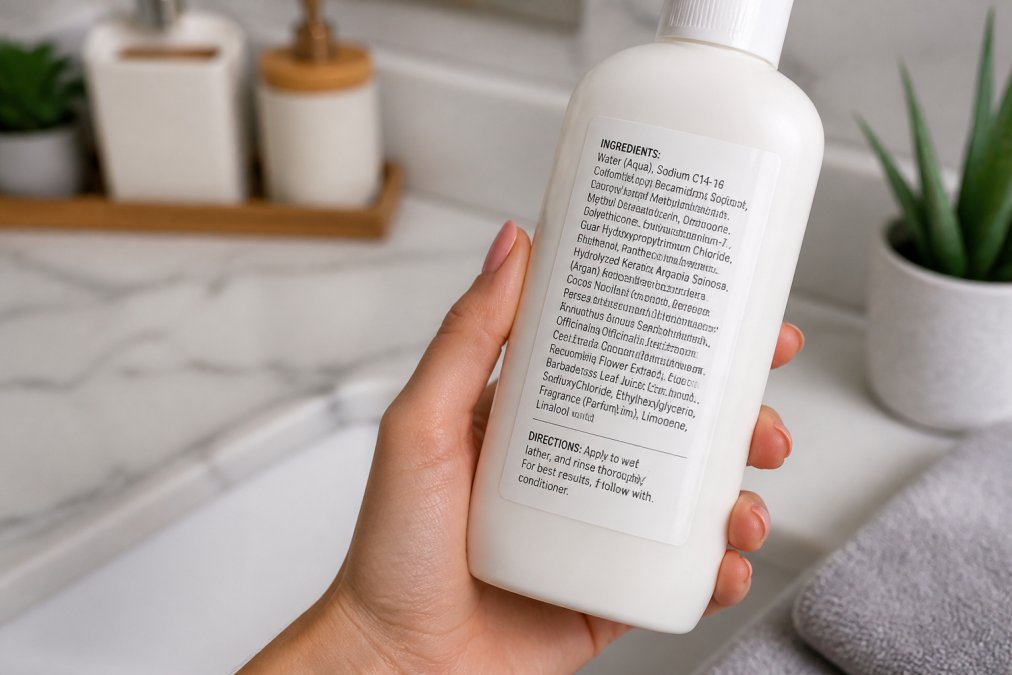
Hydrolyzed keratin, silk amino acids, and hydrolyzed wheat or rice protein work because they are broken into fragments small enough to slip past the raised edges of a damaged cuticle. Once inside, they adsorb onto the cortex and fill microscopic gaps left by bond breakage. The key word is adsorb, they sit on the surface of the fiber and temporarily reinforce it.
KERAR-PLEX STEP 1 - PRIMING SHAMPOO →
Humectants: The Moisture Side of the Equation
Panthenol (provitamin B5), glycerin, aloe vera, and hyaluronic acid draw water into the hair fiber. Panthenol is the workhorse in damaged-hair shampoos because it penetrates the cuticle, converts to pantothenic acid, and holds moisture inside the cortex rather than just on the surface. Glycerin is a stronger humectant but sits mostly on the outside and can pull moisture out of hair in very low humidity, a real trade-off in dry winter climates.
Emollients: Sealing and Friction Reduction
Argan oil, jojoba, and other plant triglycerides coat the cuticle, smooth the raised scales, and reduce the friction that causes mechanical breakage during brushing. They also slow moisture loss. The catch: heavy oils can weigh down fine or low-porosity hair, so the emollient load should match hair density.
Why the Order of Operations Matters
This is the part most guides skip. Protein without moisture makes hair stiff and snap-prone because the protein film has no plasticizer to flex with the fiber. Moisture without protein leaves hair stretchy and limp because there is no internal scaffold to hold shape. The two have to be delivered together, or in a deliberate rotation, for the cuticle to actually smooth rather than just feel coated.
Protein vs Moisture Balance for Hair: Finding the Right Ratio
Protein strengthens; moisture adds flexibility. Too much protein causes stiffness and snapping. Too much moisture causes stretchiness and limpness. The right ratio depends on your hair porosity.
Ingredients to Avoid in a Shampoo for Damaged Hair
Sulfates, parabens, and non-water-soluble silicones are the three ingredient groups most likely to undermine repair. Sulfates strip natural oils and fade color. Parabens raise scalp sensitivity concerns for some users. Silicones coat the hair with a temporary shine that masks damage while blocking real treatment from penetrating.
Building a Hair Care Routine for Damaged Hair That Actually Works
A hair care routine for damaged hair works when it is consistent, gentle, and matched to your damage type. The sequence matters as much as the products.
- Wash two to three times per week with a sulfate-free shampoo for damaged hair. Daily washing strips the scalp microbiome and sebum production that protect the hair shaft.
- Apply a deep conditioning mask weekly. Leave it on for 10-20 minutes to let hydrolyzed keratin and amino acids penetrate.
- Use a leave-in treatment serum on damp hair before styling to seal the cuticle and provide heat protection.
- Reduce heat styling to two sessions per week or less. Heat styling damage is cumulative.
- Trim every 8-10 weeks to prevent split ends from traveling up the shaft.
| Routine Step | Frequency | Purpose |
|---|---|---|
| Sulfate-free shampoo | 2-3x weekly | Gentle cleanse, preserve oils |
| Deep conditioning mask | 1x weekly | Protein and moisture infusion |
| Leave-in serum | After each wash | Seal cuticle, heat protection |
| Clarifying shampoo | 1x weekly | Remove product buildup |
| Trim | Every 8-10 weeks | Stop split ends spreading |
Transition Period Expectations: What Changes After You Switch
Switching to a sulfate-free, protein-rich shampoo for damaged hair triggers a transition period that most guides skip. Your scalp and hair need two to four weeks to adjust.
Expect the following timeline:
- Week 1: Hair may feel slightly heavier or less "squeaky clean." This is normal; sulfates were stripping natural oils.
- Week 2-3: Sebum production stabilizes. Frizz often decreases as the cuticle smooths.
- Week 4: Elasticity improves. Breakage slows. Color-treated hair holds vibrancy longer.
Conclusion: Making the Right Choice for Your Hair
Choosing the right shampoo for damaged hair comes down to three decisions: identify whether your damage is chemical, mechanical, or both; match your protein-to-moisture ratio to your porosity; and commit to a routine for at least four weeks before judging results. Most people quit at week two, right before the transition pays off.
Frequently Asked Questions
What type of shampoo is best for damaged hair?
The best shampoo for damaged hair is sulfate-free and contains reparative ingredients like hydrolyzed keratin, amino acids, and emollients such as argan oil. Look for formulas that address your specific damage type: protein-rich for breakage, moisturizing for dryness, or bond-building for chemical damage. Avoid harsh surfactants that strip natural oils and worsen cuticle damage.
How do I know if my hair is damaged or just dry?
Dry hair feels rough and lacks shine but improves with conditioning. Damaged hair shows structural signs: split ends that travel up the hair shaft, breakage when wet, loss of elasticity (hair snaps instead of stretching), and rough texture that stays after deep conditioning. If your hair tangles easily and feels gummy when wet, that points to damage rather than simple dryness.
Can keratin-infused shampoos really repair hair damage?
Keratin-infused shampoos can temporarily fill gaps in the hair cuticle and improve smoothness, but they do not permanently repair structural damage. Hydrolyzed keratin and amino acids bind to the hair shaft, reducing breakage and improving manageability between washes. For lasting results, pair a keratin shampoo with a bond-building treatment and avoid sulfates that strip the protein away.
How often should I wash damaged hair to prevent further breakage?
Wash damaged hair two to three times per week at most. Over-washing strips sebum and weakens the hair shaft, leading to more breakage. Use a sulfate-free shampoo for damaged hair and focus lather on the scalp, letting runoff cleanse the ends. Between washes, use dry shampoo or rinse with cool water to refresh without stripping.