
Table of Contents
- Why Hair Breaks Overnight: Friction, Tension, and Moisture Loss
- Protective Hairstyles for Sleeping That Actually Stay Put
- Silk vs Satin Pillowcase for Hair: What the Fabric Actually Does
- How to Use Hair Serum Before Bed Without Weighing Hair Down
- Detangling, Bonnets, and Hair Ties: The Rest of Your Night Routine
- Nighttime Care for Extensions, Wigs, and Over-Processed Hair
- Common Mistakes That Cause Hair Breakage While Sleeping
- Conclusion
- Frequently Asked Questions
Last Updated: October 1, 2026
Why Hair Breaks Overnight: Friction, Tension, and Moisture Loss
Most people blame styling tools, but the real culprit works the night shift: your hair is at its most fragile when you're unconscious.
Hair breakage isn't random; it follows a predictable path.
How Tossing and Turning Damages the Hair Cuticle
The hair cuticle is the outer layer of each strand, made of overlapping scales. Rubbing against a cotton pillowcase lifts and catches those scales until they wear away.
Protective Hairstyles for Sleeping That Actually Stay Put
The best protective hairstyle for sleeping keeps hair contained without pulling the scalp. Loose is the key word, anything tight enough to leave a mark is too tight. But "loose" looks different on a 4C coil than on fine, straight hair.
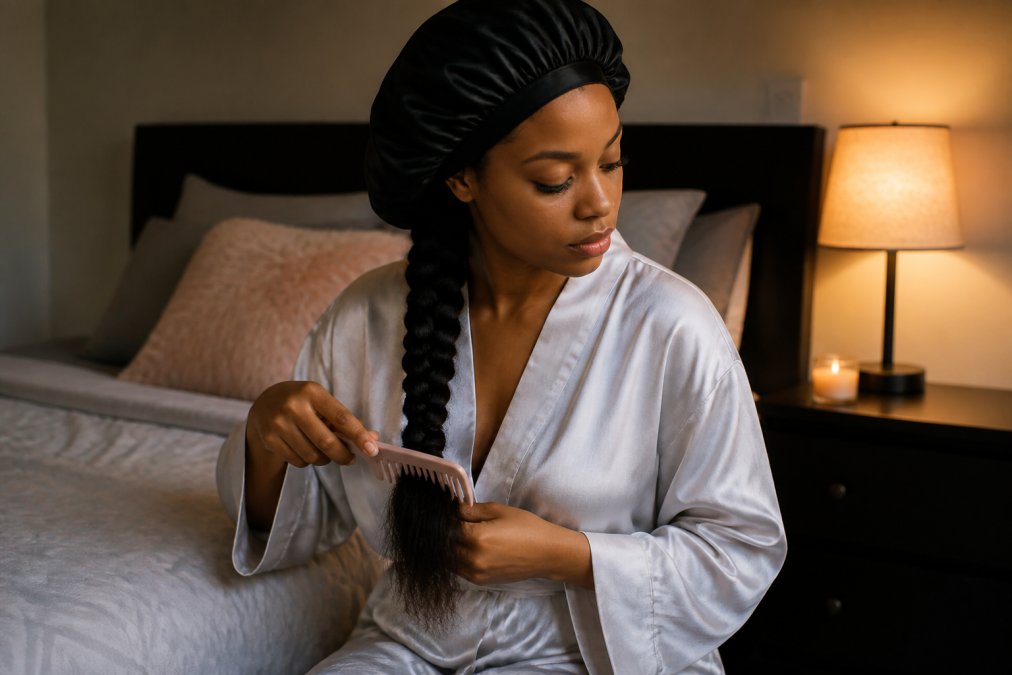
Loose Braids, Buns, and Pineapples by Hair Texture
Match the style to your texture:
- Straight, fine hair: A single loose braid or low bun. Avoid a high pineapple, which creases fine strands. For long hair, a loose English braid started at the nape keeps ends off the pillow.
- Wavy hair: A loose braid over one shoulder preserves the wave pattern and cuts tangles; a tight braid flattens the wave.
- Curly hair: The "pineapple", a high loose ponytail near the forehead, protects curl shape. Use a satin scrunchie and stop tightening once hair is gathered. Long curls do better in a loose two-strand twist.
- Coily and textured hair: Two to four loose braids or twists plus a satin bonnet. Section evenly first; uneven sections put more tension on smaller braids.
Secure any style with a satin scrunchie, never a bare elastic band, which digs into the shaft and causes breakage at the tie point.
How Porosity Changes the Style You Should Choose
Porosity matters as much as texture:
- Low-porosity hair (cuticle lies flat, water beads) holds moisture but resists leave-ins. A loose style with minimal product is enough; heavy oils sit on top and attract lint.
- High-porosity hair (cuticle raised, dries fast, feels rough) loses moisture overnight. Pair a loose style with a light leave-in and satin bonnet so moisture stays in the strand.
Unsure which you have? Drop a clean strand into water. Floating for minutes before sinking suggests low porosity; sinking quickly suggests high. It's a rough test, but it points you toward the right routine.
Tension Rules That Apply to Every Texture
Tension damage is cumulative: a style that feels fine one night can cause traction breakage after a week. Three rules keep any style safe:
- Two-finger test: Slide two fingers under the band or braid base without resistance. If you can't, it's too tight.
- Rotate anchor points: Move the base of your braid or bun every few nights; repeated tension on one spot weakens the follicle.
- No metal, no sharp edges: Use covered elastics, satin scrunchies, and seamless combs only. Metal clasps and exposed wire snag the cuticle.
When to Skip the Style Entirely
Not every head needs to be tied up. Very short hair, a fresh silk press, and some fine, straight textures do better loose inside a satin bonnet or on a satin pillowcase. The goal is reducing friction and tension, not following a rule.
Silk vs Satin Pillowcase for Hair: What the Fabric Actually Does
Silk and satin both reduce friction far better than cotton, which is why both appear in nearly every guide to preventing hair breakage while sleeping. The difference is what they are.
How to Use Hair Serum Before Bed Without Weighing Hair Down
A bedtime serum or nourishing oil adds a protective layer that helps hair hold moisture and resist friction. Use less than you think you need.
Choosing Between Oils and Leave-In Serums
Oils seal moisture in; leave-in serums add moisture and slip. Many people benefit from both in a light layer.
FIBERPLASTY BIOLAMINATING ANTI-FRIZZ →
Detangling, Bonnets, and Hair Ties: The Rest of Your Night Routine
Detangle before bed, never in the morning. Hair that's already tangled when you lie down will only tangle tighter overnight.
Then choose your protection:
- Hair bonnet or wrap: Best for curly, coily, and textured hair. Keeps hair off the pillow entirely.
- Satin scrunchie: The safest tie for a loose braid or bun. No metal, no sharp edges.
- Satin pillowcase: A backup layer for anyone who pulls off bonnets in their sleep.
Nighttime Care for Extensions, Wigs, and Over-Processed Hair
Extensions, wigs, and chemically treated hair need extra care at night, a rough routine can undo weeks of salon work. Most guides stop at "braid it and wear a bonnet," ignoring the two things that actually drive breakage: where attachment points sit against the pillow, and which way you sleep. Adjusting your sleeping position to minimize friction at these vulnerable sites is essential to prevent hair breakage, especially when your strands have already been weakened by chemical processing.
Sleep Position and Where Breakage Actually Happens
Sleep position decides which zone takes the most friction, and where breakage shows up first.
- Side sleepers press one side of the head into the pillow for hours, so friction hits the temple-to-ends zone, exactly where tape, clip, or sew-in attachment points sit. Repeated pressure loosens them and pulls the natural hair underneath. A satin pillowcase is not optional, and rotating sides spreads the wear.
- Back sleepers put less friction on the sides but more on the crown and back of the head. A high bun or pineapple presses the crown into the pillow all night, and a sew-in or lace-front wig rubs at the back edge of the cap.
- Stomach sleepers drag the hairline and front edges of a lace front or closure across the fabric, the harshest position for any hairline attachment.
Extensions: Protect the Attachment, Not Just the Ends
For extensions, brush gently and braid loosely. Never sleep on wet extensions, the added weight pulls on attachment points while hair is weakest. Beyond that:
- Tape-in and clip-in extensions: Loosen the braid or band above the attachment so no weight hangs from the tape or clip overnight. A loose braid below is fine; a tight one above is not.
- Sew-in weaves: Keep the braided base moisturized but not saturated; dry, tight cornrows are a common source of breakage at the part line. Apply a light leave-in, then a satin scarf or bonnet over the whole head.
- Fusion and keratin-bond extensions: Avoid high heat near the bonds and keep them off the pillow. A loose low ponytail with a satin scrunchie keeps bonds from pressing into the fabric.
Wigs and Lace Fronts: Store Them, Don't Sleep in Them
Store wigs on a stand or in a satin bag. If you must sleep in one, friction against the cap edge is the main risk, especially at the hairline:
- Choose a satin or silk pillowcase to reduce drag on the lace.
- Loosen adjustable straps so the cap doesn't press a hard edge into your forehead or nape.
- Remove the wig in the morning and let your natural hair and scalp breathe before restyling.
Over-Processed Hair: Rebuild While You Sleep
Chemically relaxed, bleached, or heat-damaged hair has a raised or missing cuticle, which means it loses moisture faster than healthy hair and snaps before it stretches. Nighttime is the longest uninterrupted window you have to rebuild that moisture barrier. A keratin treatment can help rebuild strength over time. Our formaldehyde-free keratin treatments are designed to restore damaged cuticles without harsh salts or sulfates.
A Quick Rule for Every Attachment Type
If your hair has an attachment point (tape, clip, bond, braid base, or lace edge), make it the priority: reduce friction there first, keep it dry, and avoid tension above it. The ends matter, but the attachment is where the most expensive damage happens.
Common Mistakes That Cause Hair Breakage While Sleeping
The same mistakes show up again and again. Each one is easy to fix once you know what to look for.
| Mistake | Why It Damages Hair | The Fix |
|---|---|---|
| Sleeping on wet hair | Wet hair stretches and snaps easily | Dry fully or use a microfiber towel first |
| Tight ponytails or buns | Constant tension weakens the hair shaft | Switch to loose styles with satin scrunchies |
| Cotton pillowcases | Friction lifts and wears the cuticle | Use silk or satin instead |
| Skipping detangling | Tangles tighten overnight into knots | Comb through before bed, ends first |
| Overloading on oil | Weighs hair down and clogs the scalp | Use 2-3 drops, mid-lengths to ends only |
| Bare elastic bands | Dig into hair and cause breakage | Always use a satin scrunchie |
Conclusion
Preventing hair breakage while sleeping comes down to three things: less friction, less tension, and more moisture. Get those right, and your morning routine gets easier too.
Frequently Asked Questions
What is the healthiest way to wear your hair at night?
Loose is better than tight. A loose braid, a low bun held with a silk scrunchie, or a pineapple on top of the head keeps strands contained without pulling at the roots. The goal is to limit friction and tension at the same time. Tight ponytails and rigid elastics create constant pull overnight, which weakens the hair shaft near the scalp. Pair the style with a silk pillowcase or satin bonnet and you cover both the friction and the moisture side of preventing hair breakage while sleeping.
Is a silk or satin pillowcase better for hair?
Both reduce friction far better than cotton, which grips the hair cuticle and causes tangles as you move. Silk is a natural protein fiber with a smooth, cool surface and breathability. Satin refers to the weave, not the fiber, so satin can be polyester or silk. For most people, either works for breakage prevention. If you sleep hot or have sensitive skin, silk tends to feel cooler. Whichever you choose, wash it weekly with a gentle detergent to keep the surface smooth.
Does sleeping with hair tied up cause breakage?
It can, if the tie is tight or the elastic has a metal clasp. Tension applied for seven or eight hours stresses the hair shaft and can lead to breakage along the part line and temples. Switch to a silk scrunchie or a fabric-covered tie, and keep the style loose enough that you can slip two fingers between the band and your scalp. Rotating where you place the bun or braid each night also spreads the tension instead of concentrating it in one spot.
How does keratin help prevent hair breakage?
Keratin is the protein your hair is largely made of. Over-processing, heat styling, and chemical treatments strip it out, leaving gaps in the hair shaft that snap under tension. Leave-in products with hydrolyzed keratin, like the Fiberplasty Cuticle Resurfacing Leave-In Conditioner, deposit protein fragments that fill those gaps and smooth the cuticle. Applied before bed, it works with your overnight hours instead of against them. Look for formulas that also include ceramides and humectants so moisture stays locked in.