
Table of Contents
- What Is Anti-Frizz Serum and Why It Matters
- How to Apply Anti-Frizz Serum Correctly: Step-by-Step
- Wet vs. Dry Hair Application for Frizz Control
- How Much Hair Serum to Use for Best Results
- Common Mistakes When Applying Hair Serum
- Hair Porosity and Serum Application
- Layering Serums With Other Hair Products
- Frequently Asked Questions
Last Updated: September 22, 2026
What Is Anti-Frizz Serum and Why It Matters
Anti-frizz serum is a lightweight, oil-based treatment designed to smooth the hair cuticle and lock in moisture. It works by coating the hair shaft with a protective barrier that prevents humidity from causing frizz and flyaways. The serum also enhances shine by allowing light to reflect evenly across the hair surface.

Frizz occurs when the hair cuticle lifts and moisture penetrates the cortex. The right serum seals that cuticle back down and prevents the problem before it starts.
Quality serums contain natural oils and emollients that nourish without greasy residue, making them essential for over-processed or humidity-prone hair.
Application technique determines whether you get smooth, shiny results or limp, heavy hair. This guide covers the exact method that works.
How to Apply Anti-Frizz Serum Correctly: Step-by-Step
Correct application requires precision: too much product creates oiliness, too little misses the benefit. The steps below ensure even distribution.
Step 1: Choose Your Starting Point
Start with towel-dried, damp hair, not soaking wet or completely dry. Excess water dilutes the serum; if hair is dry, lightly mist it with water.
Apply serum while the cuticle is slightly open from moisture, allowing penetration. Waiting until hair is completely dry makes the serum sit on the surface instead.
Step 2: Measure the Right Amount
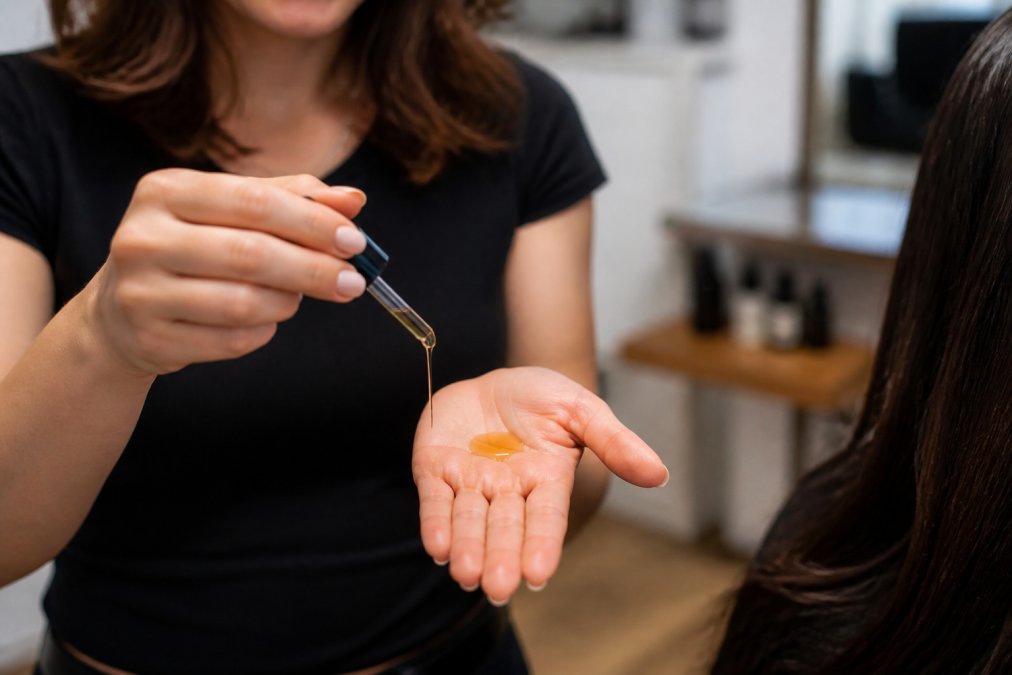
Use a dime-size amount for short to medium hair, or a quarter-size for longer or thicker hair. Using too much is the most common mistake.
Start small, you can always add more. Excess serum weighs hair down and creates a greasy, unwashed look.
Step 3: Emulsify and Distribute
Rub the serum between your palms using a pressing motion. Emulsifying breaks it into smaller particles, distributes it evenly, and prevents applying all product to one section.
Rub your palms together for 3-5 seconds until the serum feels warm and slightly thinner, which helps it spread more easily.
Step 4: Focus on Mid-Lengths and Ends
Apply serum to mid-lengths and ends first, these areas are driest and most prone to frizz. Avoid the scalp and roots, which will look flat and greasy.
Use your fingers to distribute serum evenly from mid-length to tips, paying extra attention to the ends where damage accumulates.
Run your fingers through once more to catch missed sections. The goal is invisible coverage, not visible buildup.
Wet vs. Dry Hair Application for Frizz Control
The moisture state of your hair when you apply serum fundamentally changes how the product performs and how long its benefits last. Understanding these differences helps you choose the right application timing for your goals.
Damp hair application (the professional standard). When hair is towel-dried and damp, the open cuticle allows serum to penetrate the cortex. As hair dries, the serum becomes trapped within the cuticle layers, creating a long-lasting moisture barrier. Water acts as a carrier, helping the product spread evenly without clumping. The result is frizz control lasting through your entire day, even in humid conditions. This is why professionals recommend damp application as the primary method.
Dry hair application (the quick-fix method). On dry hair, the sealed cuticle prevents penetration; serum only coats the surface. This smooths flyaways and adds shine immediately, useful for touch-ups or mid-day emergencies, but provides only temporary frizz control (2-4 hours). Use less product since there's nowhere to absorb. Dry application works best as maintenance between showers, not as your primary method.
Timing considerations for maximum benefit. Apply serum within 5-10 minutes after towel-drying, when hair is damp enough for penetration but not so wet that water dilutes the product. Waiting until completely dry loses the penetration benefit; applying to soaking wet hair causes it to rinse away.
Combining both methods in your routine. Apply serum to damp hair post-shower for deep frizz control, then use a small amount on dry hair mid-day if needed. Dry application uses roughly half the product amount.
How Much Hair Serum to Use for Best Results
The right amount depends on hair length, texture, and thickness. Using too much is the most common mistake.
Short hair (chin-length or shorter): Use a dime-size amount. This is enough to coat all strands without buildup.
Medium hair (shoulder-length): Use a dime to quarter-size amount. Start with less and add more only if needed.
FIBERPLASTY BIOLAMINATING ANTI-FRIZZ →
Long hair (past shoulder-length): Use a quarter-size amount, or slightly larger for very thick hair. For very long hair, you may need to apply in two sections: upper mid-lengths and lower mid-lengths to ends.
Thick or textured hair: Use a quarter-size amount. Textured hair has more surface area, so it typically needs more product than straight hair.
Fine or thin hair: Use less than a dime-size amount. Fine hair is easily weighed down, so restraint is essential.
Start with less product than you think you need, you can always add more. Most people see better results using less serum applied more frequently than using too much once.
Common Mistakes When Applying Hair Serum
Understanding what not to do is just as important as knowing what to do. These mistakes undo the benefits of even high-quality products.
Applying to soaking wet hair. Water dilutes the serum and causes it to slide off. Wait until hair is damp, not dripping.
Using too much product. Excess serum makes hair look greasy, flat, and weighed down, and builds up over time, making hair dull instead of shiny.
Applying serum to the scalp and roots. This area produces natural oils and doesn't need additional moisture. Serum applied here makes your hair look unwashed and greasy within hours.

Skipping the emulsifying step. This causes uneven distribution, leaving some areas dry and frizzy.
Not distributing evenly. Haphazard application leaves some strands coated and others untouched. Take time to work the serum through slowly and methodically.
Applying to completely dry hair as a routine. While dry application works for touch-ups, it doesn't provide the conditioning benefit of damp application. Serum works best when the cuticle is slightly open.
Using serum as a substitute for deep conditioning. Serums add shine and frizz control but don't replace the moisture that deep conditioners provide. Use both as part of a complete routine.
Hair Porosity and Serum Application
Hair porosity determines how well your hair absorbs and retains moisture. Understanding your porosity helps you choose the right serum type and application frequency.
Low porosity hair has a tightly sealed cuticle that resists moisture absorption. Serums can sit on the surface instead of penetrating. If you have low porosity hair, use less serum and focus on lighter, water-based formulas. Apply to damp hair to help the product penetrate. You may not need serum every day; 2-3 times per week may be sufficient.
Medium porosity hair absorbs and retains moisture well. This hair type responds best to regular serum application. You can use a standard amount and apply it to damp hair as part of your routine. Most people have medium porosity hair.
High porosity hair absorbs moisture quickly but loses it just as fast. This hair type benefits from heavier, oil-based serums that seal the cuticle and lock moisture in. You may need to apply serum more frequently, even daily for some people. Oil-based serums work particularly well for high porosity hair.
To determine your porosity, do a simple test: drop a clean strand of hair into a glass of water. If it sinks immediately, you have high porosity. If it floats, you have low porosity. If it sinks slowly, you have medium porosity.
Layering Serums With Other Hair Products
Serums work best as part of a complete hair care routine, but the order in which you apply products and how much of each you use directly impacts whether you get frizz control or product buildup. Understanding product interactions prevents wasted money and disappointing results.
The layering principle: lightest to heaviest. Apply products in order from thinnest consistency to thickest.
- Serum alone: Use your full measured amount (dime to quarter-size).
- Serum + one other product: Reduce serum by 20 percent (use slightly less than a full dime or quarter).
- Serum + two other products: Reduce serum by 30 to 40 percent (use about half your normal amount).
- More than three products: Reconsider your routine. Most hair types don't need more than three products in one application; additional layers typically cause buildup rather than additional benefit.
Frequently Asked Questions
Should I apply anti-frizz serum to wet or dry hair?
Apply anti-frizz serum to towel-dried, damp hair for best results. Damp hair allows the serum to penetrate the hair shaft and coat the cuticle more effectively. Applying to soaking wet hair dilutes the serum, while applying to completely dry hair can trap moisture and create greasy buildup. Towel-dry first, then apply the serum to distribute it evenly through your mid-lengths and ends.
How much hair serum should I use?
A dime-size amount is the standard starting point for most hair lengths and textures. Rub it between your palms to emulsify it, then apply to your hair. If you have very thick or long hair, you may need a quarter-size amount. Too much serum leaves greasy residue and product buildup; too little won't provide adequate frizz control or shine enhancement. Start small and adjust based on your hair's response.
What are the most common mistakes when applying hair serum?
The biggest mistakes are applying serum to the scalp (which causes greasiness), using too much product, and applying to completely dry hair instead of damp hair. Many people also fail to emulsify the serum in their palms before distributing it, leading to uneven coating and product concentration. Applying only to the ends without covering mid-lengths leaves the rest of your hair unprotected. Always focus on the mid-lengths and ends, use a pressing motion rather than rubbing, and avoid the roots.
Can I apply anti-frizz serum to my scalp?
No, avoid applying serum directly to your scalp. Anti-frizz serums are designed for the hair shaft, not scalp health. Applying to the roots causes greasy residue, product buildup, and can weigh down your hair at the crown. Instead, apply the serum starting from mid-length downward, keeping it focused on the areas most prone to frizz and damage, typically the mid-lengths and ends of your hair.